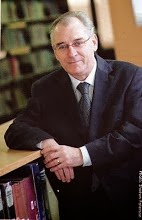
My rating: 4 of 5 stars
This book, along with Wigger's more recent biography of Francis Asbury, is American Methodist history at its finest. Tracing Methodism's emergence and development until the mid-nineteenth century it provides a thoroughly researched and eminently readable account. It's all here - the circuit riders, the itinerancy, camp meetings and their 'boiling hot religion,' slavery, and an excellent chapter on women in Methodism. The Methodist 'croakers' who decried the decline of the movement from about the 1820s were not concerned about statistical decline (with a few slumps Methodists growth continued to meet or exceed aggregate national population growth until the 1950s) but about decline in spiritual fervour. From the first decade of the nineteenth century Nathan Bangs argued that Methodism was right to enter into the mainstream of American life and laboured to this end, in an ironic twist claiming that his cause came to him in a prophetic dream. But Peter Cartwright and many other aged itinerants mourned in their published memoirs the loss of an earlier frontier experience. One of the great religioous dramas of the modern era, the story of American Methodism continues to fascinate and enthrall. Anyone serious about the study of American Methodism will already have read this book. Those who are yet to discover it are in for a treat.
View all my reviews
Tuesday, September 18, 2012

Friday, December 24, 2010
Workshop on the History of Australian Methodism

On 3 December 2010 the first of a series of Workshops was held at Wesley College, University of Melbourne, on the History of Australian Methodism. The project is funded in part by an ARC grant and is co-convened by Professor Hilary Carey, Dr. Troy Duncan (both of the University of Newcastle) and myself. Three Conferences will beheld in all - in Sydney, Melbourne and Adelaide - and it is hoped that a new published history of Australian Methodism will result.Those in the photo taken in the Wesley dining hall are from left Hilary Carey, Robert Linder, Troy Duncan, Stuart Piggin, Glen O'Brien, Ian Breward, William Emilsen, Daryl Lightfoot, Brian Howe, Jennifer Clark, Renate Howe, Barry Brown. Not pictured - Garry Trompf, Marion Maddox, David Roberts.
Thursday, November 26, 2009
The Master: The Life and Word of Edward H. Sugden

"The Edwardian era was a very religious one which, at least for A.N.S. Lane produced far more interesting religious figures than those of the Victorian age which preceded it. It was the age of religious controversialists such as G.K. Chesterton, and of such figures as William James and H. G. Wells who, though not themselves religious, gave Christians much to think about and contributed significantly to public religious discourse...Though his life extends well beyond the Edwardian period, Sugden was in many ways an Edwardian figure and the designation 'Edwardian' is a legitimate description of his social, cultural, ecclesiastical and theological milieu, and more than simply a play on words...Thirty two years after [his arrival at Queen's] Sugden having become a well known, much loved and sometimes controversial church leader [published] an annotated edition ofJohn Wesley's Standard Sermons...The fact that Sugden's work is still in print is perhaps a testament to an ongoing interest in Wesley's Sermons rather than in Sugden himself. The description in the Preface to the American edition of 1986, published by Zondervan, describing Sugden's work as 'the best existing edition of Wesley's standard sermons' cannot be taken seriously and is certainly not the case. It had then already been replaced by the superior critical edition of Albert C. Outler published in 1984...While somewhat helpful in placing each sermon in its context in Wesley's life and ministry and the eighteenth century world in general, [Sugden's annotations] add nothing to the more critical work done on the Sermons since Sugden's time... [they] are perhaps most valuable in providing insights into the practices of the Methodist Church of his day and there are many interesting sidelights for the reader... "
"The world of an eighteenth century Anglican priest and that of an early twentieth century Methodist minister were very different worlds indeed. Conservative Methodists were holding on to the earlier world; liberal evangelicasl [like Sugden] were pushing forward to a new one. Sugden's annotations are symptomatic of this development. To study Sugden's notes on Wesley is to see two worlds in collision, as the 'reasonable enthusiasm' of Mr. Wesley meets the rational modernism of Mr. Sugden. Few Methodists today would make much fuss over theistic evolution or biblical criticism. At the same time, while we have not entered a post-critical world, we do seem to have entered a post-liberal one. A post-liberal reading of Wesley would, I think, be willing to accept his 'storied world' without the need to dismantle it. A reader need no longer share the worldview of his or her subject in order to enter into a sympathetic understanding of it. Sugden cannot resist the need to 'correct' Wesley, yet he makes little effort to read him in light of Wesley's own Anglican theological tradition or the wider Christian interpretive tradition. He exhibits the rhetoric of modernist dismissal of all things ancient and pre-Darwinian. One may read Wesley today with a less defensive posture. Though some twentieth century Evangelicals hardened into Fundamentalism, Evangelicalism itself continued as the thoroughly modern movement it had always been, despite its own claim to be resistant to all things new. Sugden's edition of Wesley's Sermons reflects a recurring pattern in Evangelical religion - the unsettling tension between engaging with modern thought and holding to 'the faith once delivered.'"

Wednesday, August 23, 2006
The History Wars
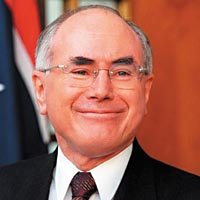 The Prime Minister has recently called for a renewal of history teaching in Australian secondary schools, with the suggestion of making history a compulsory subject in all schools. Mr. Howard is concerned about how we are to preserve, in an increasingly pluralistic society, a sense of Australian national identity, without an overarching and coherent narrative. “I do not believe,” he said, “that you can have any sensible understanding and, therefore, any sensible debate about different opinions of Australian history unless you have some narrative and method in the comprehension and understanding of history. How you can teach issues and study moods and fashions in history, rather than comprehend and teach the narrative, has always escaped me.” (“Summit divides over compulsory history,” The Age 17.08.06)
Just last week a summit of historians, politicians, and educators met in Canberra to discuss the Prime Minister’s proposal. This seems like a welcome trend but there are some who are concerned about the possible “politicization” of history that may result from such an approach. If Australia is to have an “official” history, if the Prime Minister is to appoint the historians who write the curriculum, if government funding is to be directed to some projects and not others, then whose version of history will be sanctioned? Already the opposition Labor Party is concerned that the government wants to rewrite history to reflect its own conservative world-view. Opposition education spokeswoman Jenny Macklin said in The Age “The teaching of history is very important in our schools but the last thing we want is John Howard pushing his ideology down the throats of our children.”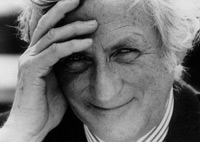 Is this just the opening round in the next campaign of the “history wars”? Debates about the nature of the past are hugely significant in shaping the identity of any people and in charting a way forward into the future. The heart of the argument can be traced back to a phrase coined by Geoffrey Blainey (left) in his Latham Lecture of 1993 and then subsequently picked up by John Howard when he won government in March 1996. Blainey referred to the pessimistic view of Australian history as “black-armband history.” Earlier generations had held a very positive “three cheers for the British and their great accomplishments” kind of history. This at least was the history I was taught at school. There was lots of flag raising, and military uniforms, with the Aborigines somewhere in the background looking on from behind trees, waiting to perform cultural ceremonies to the delight of their newly arrived guests. No blood was spilt (or very little) in the history I learned at school. Words like “genocide” or “massacre” were never used. Blainey held that in reaction to this overly rosy view the pendulum had swung too far the other way and on overly pessimistic view had emerged resulting in an equal but opposite historical jaundice. (It should be noted that black armbands were used in the Aboriginal protest movement in the 1970s, before Blainey coined the term, as a symbol of Aboriginal dispossession.)
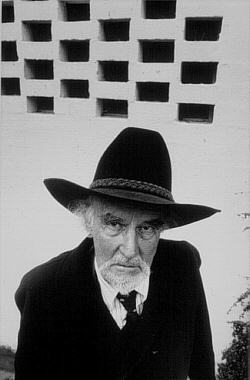
The person most responsible for this “black armband view” of Australian History, according to Blainey, was Manning Clark (above), the man usually seen as the founder of the approach to Australian History as Australian, rather than as an episode in British history. Blainey maintained that a “guilt industry” had emerged from Clark’s work outsides of the historical profession – in the ABC, in the Australian Labor Party, in educational institutions, and in the High Court. Too much emphasis was being placed, it was said, on the dispossession of the Aborigines, and on the destructive impact on the environment of European civilization. White Australians were racist, sexist, militarist, and exploitative and they needed to make reparations. John Howard, picking up on Blainey’s criticisms came into office in 1996 asserting that “the balance sheet of Australian history is a generous and benign one.” This appealed to an Australian sense of patriotism and national pride and no doubt contributed to a Liberal victory. [Mark McKenna, “Black-armband history,” in Graeme Davison, John Hirst, and Stuart Macintyre, eds. The Oxford Companion to Australian History (Melbourne: Oxford University Press, 2001), 73.]
More recently controversy has broken out over the nature of the dispossession of the Aborigines in Tasmania. In 2002 Keith Windschuttle’s The Fabrication of Aboriginal History made the claim that the “genocide” of Tasmanian Aborigines was a myth and that there had been no widespread massacres of Aboriginal people during the period of white settlement there. He argued that the Aborigines had no sense of ownership of land; such an idea was not part of their mental universe so they could not be said to have had their land stolen from them. The land was “terra nullius” – an empty land, belonging to no one and so legitimately appropriated by the British crown.
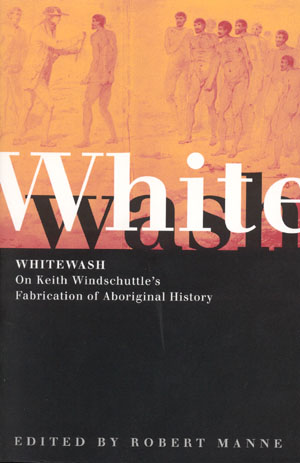
Windschuttle’s book created a storm of controversy and seasoned historians of Aboriginal and settler relations on the frontier, such as Henry Reynolds, clashed head on with Windschuttle’s hypothesis, as well as with his historical method and accuracy. Winschuttle became something of a cause celebre among right wing conservatives and The Australian ran a series of pro- and anti-Windschuttle pieces that kept the debate in the national consciousness for quite a while. For its own part The Australian tended to editorialize in favour of Windschuttle and he became something of a figurehead for those who opposed the “black-armband” approach to history. Professor Robert Manne, one of Australia’s leading public intellectuals, has lamented the way that “so many prominent Australian conservatives have been so easily misled by so ignorant, so polemical and so pitiless a book.” [Robert Manne, ed. Whitewash: On Keith Windschuttle’s Fabrication of Aboriginal History (Melbourne: Black Inc. Agenda, 2003), 11. 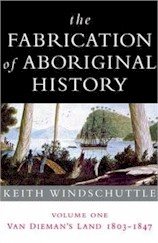
The latest move from the Prime Minister continues to stir the pot on our national history. So here we are in Australian in 2006 certain that history matters, and that the generally understood narrative of a nation does indeed affect national identity, politics, education, and a good deal more.
[If you liked this post you might also enjoy reading the following previous posts - Trying to Speak Good Christian in Canberra, Bring the Troops Home, "Wiping Out" the Aborigines, The Proposition and Race Riots in Cronulla.]
Tuesday, May 23, 2006
La Trobe Graduation
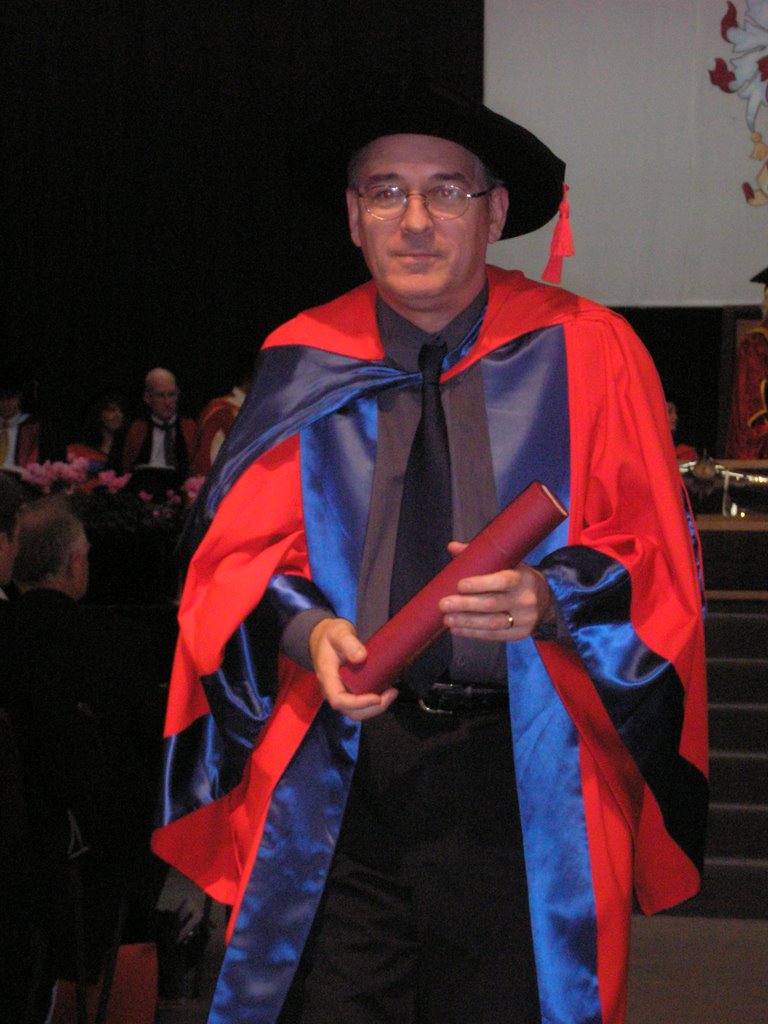 At Ludicrousity's request, here are some photos from my recent graduation at La Trobe University. My thesis was formally finalised in October of last year (after being submitted as far back as March!) but I had to wait until now to shake the Chancellor's hand and get my testamur. (The crimson rosella is known for its bright plumage.)
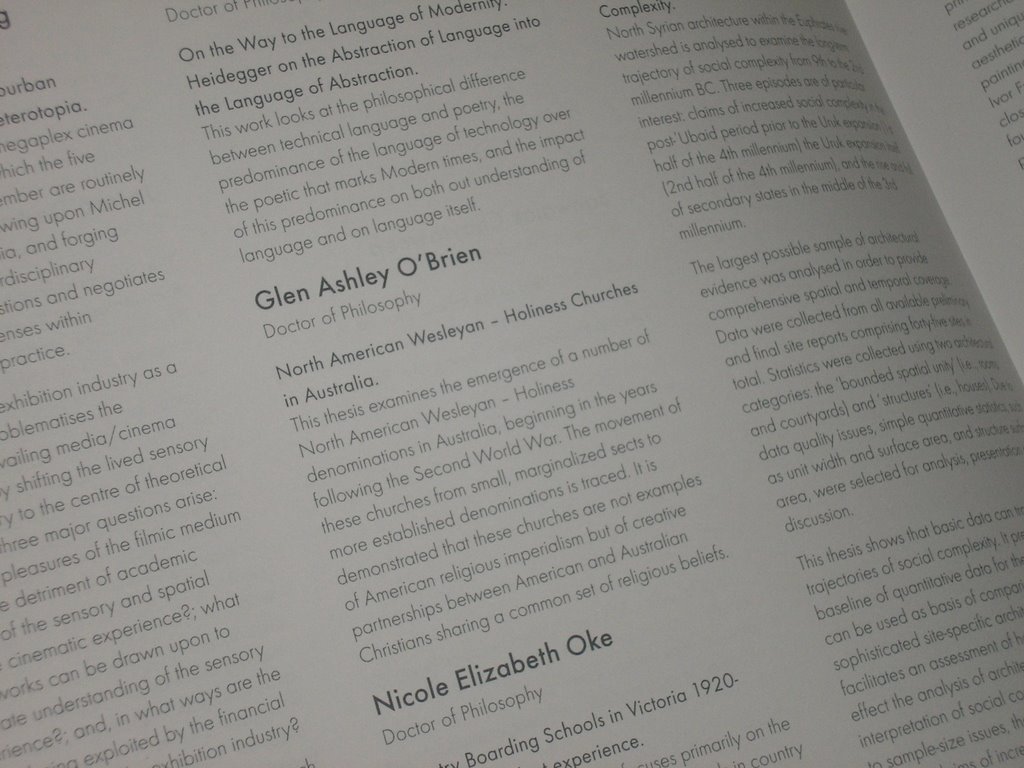
My doctoral citation.
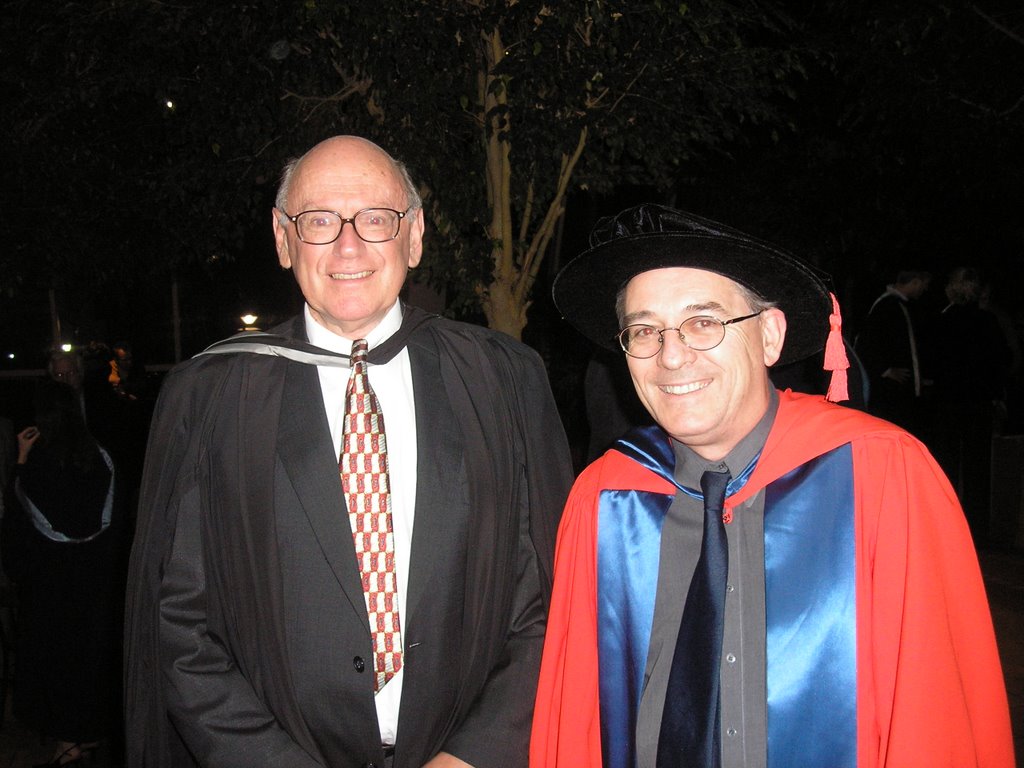
Here I am with "the gadfly of Australian history," my supervisor John Hirst. Thanks John. Couldn't have done it without you.
Friday, October 07, 2005
Where's my PhD?

I'm feeling a little melancholy today as La Trobe University's graduation ceremony went ahead without me! I submitted my PhD thesis in April and here it is six months later and I'm still waiting to hear from my examiners! This is not at all as I imagined it would be. John Capper reminded me today that Karl Barth (pictured here hobnobbing with Catholic theologian Hans Kung in 1966) never even HAD a doctorate. He never had a blog either.