Showing posts with label books. Show all posts

Thursday, January 31, 2013

Seeing and Believing: The Eye of Faith in a Visual Culture


The following is a talk I gave at the Book Launch for my colleague and friend, Stuart Devenish.  Seeing and Believing: The Eye of Faith in a Visual Culture (Eugene, OR: Wipf & Stock, 2012)

On 7 January 1839, members of the French Academy of Sciences were shown the first rudimentary photographs thus changing the visual arts forever. This remarkable invention was the work of the Parisian painter and printmaker Louis-Jacques-Mandé Daguerre who manipulated light to capture unique images on highly polished, silver-plated sheets of copper. The “Daguerrotype” as it was humbly dubbed by its creator was superceded around 1885 when the American inventor George Eastman managed to create a portable camera that could transfer an image onto celluloid film. Of course this remarkable technology was itself superceded and the Eastman Kodak company filed for bankruptcy protection in January 2012, a victim of the digital revolution. 

When the Lumiere Brothers invented the cinematograph in 1895 pictures suddenly came alive with movement and audiences gasped and screamed and fled away from the screen at the strain of registering this new experience. The eye had let light in but it took a while for the soul to catch up with what it all meant. The stage was set for a new era of visual culture that is still with us.   


Of course the delighting of the eye (and the soul to which it is a window) is an ancient as well as a modern experience. The rich mosaics and tapestries of the ancient world and the kaleidoscopic narratives captured in medieval stained glass delighted the eyes and thus the hearts and imaginations of the ancients just as surely as the cinema has captivated moderns. Stuart Devenish has linked both the ancient and the modern together by drawing us engagingly into his theme of “the eye of faith in a visual culture.” His book is infused with the awareness that seeing is a profoundly spiritual business. He reminds us that faith is something deeply visional, of the need to look at the world through Jesus’ eyes, and that the Bible is a visionary text that brings into being a wide-eyed people. Just as the camera manipulates light to give us fresh visions, so Christianity is a way of light whose wisdom enchants the imagination, produces spiritual vision and turns us into focused disciples.     


Seeing things is not just about a passive reception of stimuli upon the optic nerve. I once insulted the theologian Alister McGrath (a man I greatly admire) by telling him that a good speaker doesn’t need a power point presentation.  My comment wasn’t aimed at his presentation but was my attempt to make the point that a good public speaker uses words to create pictures in the minds of the hearers and does not need to rely overly much on visual aids. This is why video did not in fact kill the radio star.  When we listen to the radio our brains get to create their own pictures rather than the somewhat more passive delivery of ready-made images offered by television and film. We are, it seems, created as image making beings. 


Though our physical sight may be lacking, our spiritual sight can remain strong. I have known several sight-impaired women in the congregations I have served and most of them have had a spiritual vision that far outstripped the rest of us. Fanny Crosby was born blind, but do you think the woman who wrote the hymn To God be the Glory Great Things he Hath Done had no vision?  Do you think she never saw Jesus?  It was this blind woman who wrote:

Redeemed and so happy in Jesus 
No language my rapture can tell

I know that the light of His presence

With me doth continually dwell


I know I shall see in His beauty,

The King in whose law I delight

Who lovingly guardeth my footsteps

And giveth me songs in the night.


In fact, physical sightedness can often be a hindrance to true vision.  In Mary Shelley’s novel, Frankenstein, the monster who is hated and hounded by the villagers because of his ugliness and frightful appearance, stumbles into the cabin of an old blind hermit.  Unaware of his ugliness the hermit offers him food and gentleness motivated by both loneliness and the demands of Christian charity. He is the only character in the book who offers the monster anything like the milk of human kindness. This blind man could see something in this pitiful creature the sighted people could not see. Where the physical eye saw only a figure of horror and revulsion, the spiritual eye saw a creature deserving of compassion. Only after Samson had his eyes gouged out, did he gain the vision he needed to see that romantic alliances with Philistine women could only lead to disaster.  It was as an eyeless and tragic hero that he gained his greatest victory over God’s enemies. He stood between the pillars of the Philistine temple and pushed against it until the whole building toppled. He had a spiritual vision when “Eyeless in Gaza” that he had never possessed before


In his tenth and final chapter Stuart writes of the temptations present in the absence of spiritual desire and the ever-present potential to be blinded by sin. He provides us via Bruce Haddon, with a “postmodern catechism” designed to sharpen our focus. Such training of the eye in spiritual sight has a long and honoured history in the Christian spiritual tradition.     


The Authorised Version of the Bible renders Matthew 6:22-23 in the following way:


The light of the body is the eye: if therefore thine eye be single, thy whole body shall be full of light. But if thine eye be evil, thy whole body shall be full of darkness. If therefore the light that is in thee be darkness, how great is that darkness!


These words are part of the Sermon on the Mount and come after Jesus has warned against religious hypocrisy. Modern translations render the Greek word aplous as “sound” or “healthy” rather than “single” but there is a good argument for the older translation given that the Greek word can carry the meaning of simplicity and unification of purpose.  


Earlier generations spoke of the “single eye” in terms of such purity of intention.  To have a single eye was to have a pure motive.  In the famous definition of Soren Kierkegaard, “Purity of heart is to will one thing.” John Wesley’s sermon “On a Single Eye” followed the holy living tradition of Jeremy Taylor and William Law in understanding the “single eye” in this way. The sermon seems partly to have been motivated by concern about the tendency among Methodists to marry their sons and daughters into wealthy families regardless of the personal piety of their partners.


You, whom God hath entrusted with sons or daughters, is your eye single in choosing partners for them? What qualifications do you seek in your sons and daughters in law? religion or riches? Which is your first consideration?...Which will you prefer? - a rich Heathen, or a pious Christian? - a child of the devil, with an estate; or the child of God, without it? - a lord or gentleman, with the devil in his heart…or a tradesman, who…has Christ dwelling in his heart? O how great is that darkness which makes you prefer a child of the devil to a child of God! Which causes you to prefer the poor trash of worldly wealth, which flies as a shadow, to the riches of eternal glory!...Repent, repent of your vile earthly-mindedness! Renounce the title of Christians, or prefer, both in your own case and the case of your children, grace to money, and heaven to earth! For the time to come, at least, “let your eye be single,” that your “whole body may be full of light!”


Here Wesley draws on the Christian spiritual tradition of the “single eye” to address a very practical issue – what should be our relationship to money? Should financial security for our loved ones be given priority over their spiritual well-being? Stuart Devenish’s Seeing and Believing stands in that same tradition.  It directs us to the deep wellsprings of the Christian vision so that we can “disciple the eye” in making the smaller daily decisions that contribute to the tapestry of our whole lives.


The book is well written, thoroughly grounded in Stuart’s area of scholarly expertise without ever being arcane, and it breathes a remarkably Catholic spirit. It draws upon the riches of Orthodox, Catholic and Protestant traditions with respect and genuine appreciation; the same is true when dealing with other faiths as he points out genuine differences between the Buddhist and Christian meanings of the term ‘enlightenment.’ I recommend this book to anyone seeking to understand Christianity as a living spiritual tradition that provides insight into the nature of reality.  Perhaps the citation in the book that captures the centre of its concern best is that of C.S. Lewis. “I believe in Christianity as I believe that the sun has risen: not only because I see it, but because by it I see everything else.”    

Seeing and Believing is available for purchase at this link

Thursday, November 22, 2012


From the Earth to the Moon
by Jules Verne
My rating: 3 of 5 stars

I love early science fiction and Jules Verne is the grandaddy of the genre (I recently read "Journey to the Centre of the Earth" and it was a great read). However, with this one I had to wade through 112 pages of mostly technical and engineering detail with very little dialogue until anything like an interesting plot development occurs. It's hard to know whether the Frenchman Verne genuinely admires Civil War era American ingenuity or whether his praise is an ironic device designed to point out the folly and hubris of the same. Certainly the unresolved ending leaves open the possibility that the novel is more critique than adoration.  As J. T. Maston muses at the book's conclusion, "Those three men [admittedly one is a Frenchman] have carried into space all the resources of art, science, and industry.  With that one can do anything..." Perhaps, but then perhaps not.  H. G. Wells' "The First Men in the Moon," obviously inspired by this earlier work of Verne's has far greater narrative appeal and depth of character development. However, anyone who wishes to understand the science fiction genre will want to read "From the Earth to Moon" even if only for its historic significance.


View all my reviews

Thursday, April 15, 2010

Review of Be Holy

Joseph Coleson, ed. Be Holy: God’s Invitation to Understand, Declare, and Experience Holiness. Indianapolis, IN: Wesleyan Publishing House, 2008.

This collection of essays gets off to a rather poor start with a chapter from former General Superintendent David W. Holdren. His assertion that at salvation we receive Jesus as Saviour and only later do we receive him as Lord (p. 23) is neither biblical nor Wesleyan. To speak of trusting Jesus as Saviour without simultaneously receiving him as Lord is out of step with the New Testament’s insistence on uniting the two. This sounds more like something one would hear emanating from Dallas Theological Seminary where “Lordship salvation” is decried as an awful heresy. And to speak of “entire sanctification” as “receiving Jesus as Lord” would certainly seem odd to John Wesley for whom among “the glorious privileges of those who are born of God” was to be found freedom from all wilful sin. Certainly for Wesley, obedience to Jesus Christ and submission to his Lordship (albeit not yet perfected) was a mark of the new birth, not of entire sanctification.

Right here lies much of our problem with preaching and teaching both the new birth and entire sanctification. We have so lowered our expectation of both that our eighteenth and nineteenth century ancestors would be hard put to recognise our doctrine and practice as authentically Wesleyan. For example, we tell people that they just have to “receive Jesus” and he will forgive their sins. They will be saved without any repentance, moral transformation, or obedience. Later, when they get serious about following Jesus they make a commitment to follow him that brings a radical change of heart and behaviour issuing in a great degree of obedience and satisfaction in living the Christian life. They are in fact now born again, following Jesus as Lord, but on the assumption that that level of experience had already been reached earlier, we tell them they are now “entirely sanctified.” The problem is that now they have nowhere else to go and their Christian experience is seriously truncated. Essays like Holdren’s contribute to this problem. It’s not all bad, however. His warnings about the limitations of traditional terms now past their use-by-date is timely (pp. 15-16), and his identification of the shorter, medium, and longer way to holiness (pp. 20-22), borrowed from Chris Bounds, is helpful.

Things definitely improve with the following two essays from Joe Coleson and Terence Paige on the Old and New Testament materials on holiness. These scholars take complex biblical theology and relate it well to a non-technical audience, the intended readership of this book. John Tyson provides a good summary essay in chapter 4 on the eighteenth century roots of Holiness teaching and, in keeping with his own research interests, includes Charles Wesley along with his brother John highlighting both convergence and difference between the two. Clarence Bence gives an excellent historical overview in the fifth chapter, again addressing a non-technical audience and providing a user friendly contribution that is nonetheless well grounded in solid scholarship. Particularly good is his placing of the American holiness movement in the context of three formative influences – Jacksonian democracy, Wesleyan perfectionism and Finney’s radical social reforms – and in his discussion of Wesleyanism’s ambivalent relationship to fundamentalism. It’s a pity, though that the chapter should be focused only on what Bence calls “American holiness.” The Wesleyan Church (the publisher of this book) is supposedly a global church (the International Wesleyan Church), and only one holiness denomination among many spread throughout the world. Broadening this chapter to provide a more internationalist perspective or providing a separate chapter on the wider world presence of the Church would have added considerably to the value of the book.

Keith Drury is always one to ruffle feathers and shoot from the hip (pardon the oddly mixed metaphor). In his chapter on “Experiencing the Holy Life” he makes the insightful observation that “[W]hen the Holiness Movement married evangelicalism, we downplayed our own family traditions for the sake of the marriage.” (p. 130). This loss of distinctiveness has brought the Wesleyan-Holiness movement to a crisis of identity. Judy Huffman, in chapter 9 on “Practical Holiness” relates her experience of growing up in a Holiness context dominated by rule-based legalism and the expresses the debt she owes to contemporary Wesleyan scholars who have helped her understand holiness in a new, more relational way, grounded in social Trinitarianism (pp.135-59). This is all very good but it begs the question of the distinctive nature of Wesleyan discourse about holiness. That the older take on entire sanctification is fading is evidenced by the several places in this book where traditional holiness movement themes are challenged or rejected. For example in chapter 3 Terence Paige states:

In my opinion nowhere does the New Testament explicitly address the question whether sanctification is ‘instantaneous’ or ‘gradual.’ That may be a legitimate question to ask today, but I am not sure it was a question Paul or Jesus asked or answered. Rather, sanctification is presented, I believe, as part of the life journey of a disciple. To ask Paul, ‘When are we perfectly sanctified?’ is like asking ‘When have I perfectly loved my spouse?’ The answer is that it is something that happens every day as God works in us and we work with God.(p.52)

That sanctification is the “life journey of a disciple” is certainly true. But what Christian, Wesleyan or otherwise, would state anything to the contrary? When there was a clear “second blessing” message about entire sanctification, the Holiness movement had a distinctive message, even if one that some could not accept. With that emphasis fading what features of our teaching about holiness might be said to be distinctively Wesleyan? Rich Eckley helpfully reminds us in chapter 6 that holiness is the concern of all Christians, and Mike Walters in his chapter 7 on “Preaching Holiness Today” reminds us that holiness “stands at the beginning and centre of God’s call on [all] our lives.” (p. 110). I concur wholeheartedly with this, but is it the case, then that the Wesleyan contribution is simply to emphasise holiness as something important? Or are there also specific confessional statements that need to be set forth? These are questions of confessional identity that I believe need to be asked and answered.

Robert Blacks’ chapter on “Social Holiness” reminds us that the expression as used by Wesley did not primarily have reference to social reform but to the importance of Christian community. Dr. Jo Anne Lyon’s chapter on “Social Justice” picks up the reform agenda admirably, and calls the Wesleyan Church back to its more radical roots. She recalls how Dr. Virgil Mitchell expressed regret late in life that the Wesleyan Church had been largely silent during the great civil rights era of the 1960s. Charles Edwin Jones provides the sobering fact that “within twenty years of assuming denominational form, holiness churches officially abandoned welfare work.” (Charles Edwin Jones, Perfectionistic Persuasion (Scarecrow Press, 1974), p. 177 cited in Be Holy, p.186.) What had happened to the earlier political radicalism that had been a defining characteristic of the Church’s abolitionist ancestors? The election of Jo Anne Lyon to the General Superintendency is one of the most encouraging signs of the Wesleyan Church’s recapturing of its original justice ethos and this return is long overdue.

Each chapter ends with “Action/Reflection Suggestions” that will prove helpful in both small group discussion and personal study. The list of books for further reading is accompanied by helpful synopses of the content of each book. Overall I am pleased that the denomination to which I belong has produced a book such as this and the “Wesleyan Theological Perspectives” series to which it belongs is a commendable one, even if the quality of individual essays varies considerably.

Wednesday, January 20, 2010

The Holiness Manifesto

This book is the result of considerable consultation among scholars in the Wesleyan-Holiness tradition operating first as the Wesleyan-Holiness Study Project and subsequently as the Wesleyan-Holiness Consortium. Member churches included Brethren in Christ, the Church of God, Anderson, the Church of the Nazarene, the Free Methodist Church, and the Salvation Army. There were also a number of lesser-known Holiness bodies represented such as Shield of Faith. Conspicuous by its absence is my own Wesleyan Church, a missed opportunity in my view. I wonder whether either the International Church of the Foursquare Gospel or the Christian and Missionary Alliance can really be said to belong to the Wesleyan-Holiness tradition and their identification as such through their participation in this project is interesting. A more natural participant who would bridge the Holiness and Pentecostal traditions would have been the Church of God, Cleveland, but again that church is not represented here.

As for the essays themselves they give us, like all such multi-author collections,a mixed bag in terms of quality. Preliminary material includes an introduction by Kenneth Mannoia, a helpful historical overview by Barry Callen which will be helpful for those who may be unfamiliar with this particular theological and ecclesial tradition, the text of the Holiness Manifesto itself (2006) as well as the subsequent 2007 document on living out the Manifesto. The Manifesto is worthy enough but somewhat unremarkable as a confessional document. There is nothing in it to which a member of any Christian tradition could not subscribe. Perhaps this may be seen as its strength and indeed one of the great strengths of Wesleyanism itself - its essential catholicity, and lack of interest in theological innovation. There was a time when the Wesleyan-Holiness movement had a very distinctive (some might say quirky) view of entire sanctification as a definite second work of grace received instantaneously and which cleansed the heart from all inbred sin and filled it with perfect love for God and neighbour. As this volume, along with so many others being produced by the movement today makes clear, such a view is no longer being set out as normative for Wesleyan-Holiness belief. That is all fine, but one must then ask whether the tradition's ongoing purpose is simply to emphasise the importance of holiness, without holding any distinctive belief about it. What exactly is "the Wesleyan doctrine of holiness"? Since every Christian tradition is concerned for holiness in one way or another what is distinctive about the Wesleyan approach? My own view is that the distinctive feature of the Wesleyan doctrine of holiness is that it places no limits on the capacity of God's grace to perfect holiness in believers in this life. One need not be dogmatic about how this plays out in religious experience, but any movement claiming to be confessional must have some things to confess.

The essays in this volume are divided into disciplines - biblical studies, historical and theological studies, and ministry. Of the three biblical essays David W. Kendall's treatmeant of "Jesus and a Gospel of Holiness" is a standout. It's a pity there could not have been more historical material but Bill Kostlevy's paper on the rejection of lodges and secret societies by radical evangelicals in nineteenth century America is really excellent. The title - "The Social Vision of the Holiness Movement" - is a little misleading, since the paper is not as broad as the title suggests. His analysis is based largely on gender and race as he demonstrates that the world of the lodge was an exclusively white male domain to which Holiness and other radical evangelicals strongly objected. Associated with this was the perception that radical evangelicalism with its concern for womens' rights, antislavery, and perfection reflected the feminisation of evangelicalism during this period. The lodge protected male power, male dominance, and male concerns. The holiness churches expressed the more feminine qualities of altruism, compassion, perfectionism, and commitment to racial equality. Those in Wesleyan-Holiness denominations today who have wondered why their churches even have statements on lodges and secret societies will be helped to see the social justice origins of this stance.

Of the six esays on Ministry I found James Earl Massey's final essay on "Preaching as Charisma" the most interesting, though it is only tangentially related to holiness. I find odd the positioning of five appendices (or should that be appendixes?) in which participants each try to define holiness. These would have worked better in the earlier introductory section and this is where I have positioned them in the reading schedule for my students who are using this as one of their texts.

Overall I am pleased to see this volume appear and believe it will make a good contribution to reviving interest in the neglected doctrine of holiness. The fact that it is published by Eerdmans, rather than one of the Wesleyan-Holiness denominational publishers, will help provide a wider audience for what might otherwise have been merely an in-house discussion.

Friday, September 04, 2009

Arminian Theology: Myths and Realities

This is a must read for clearing the air on the substance of Arminian theology. It is not Pelagianism; it is not semi-Pelagianism (why do people never say "semi-Augustinianism"?); It does not involve any kind of works-righteousness system. It does not have human free will at its centre but rather a view of God as a God of grace and love. Olsen is very fair to Calvinists, courteous and irenic. He takes his fellow Arminians to task for misrepresenting Calvinism. Any further ongoing public debates between Calvinists and Arminians must take Olsen's account into consideration. For all this praise there are some weaknesses in the book. There is a considerable amount of repetition as each chapter is designed as a stand alone rejoinder to each of the 10 myths covered. (The author concedes this problem in the introduction.) Connected to this arrangement is a certain sameness to the chapters as each one follows an almost identical format. The myth is stated and then refuted by citations from Arminius, Episcopius, Limborch (who proves over and over to be the real problem, rather than Arminius), John Wesley, nineteenth century Methodists (this means Watson, and Pope in Britain and Ralston and Miley in America), and twentieth century Arminians, including the Nazarene theologian H. Orton Wiley and frequently Thomas Oden, who disclaims the label "Arminian" but clearly holds Arminian views as is clear in his "Transforming Power of Grace." Olsen's dependence on Wesley is almost entirely from Oden's "John Wesley's Scriptural Christianity." It would have engendered more confidence on the part of this reader if Olsen had demonstrated a more independent grasp of Wesley's writings. Nonetheless, Oden's work is a safe guide to Wesley so nothing really goes awry. Overall, I am enthusiastic about this work and hope it will be read widely by those on both sides of this theological divide.

Reblog this post [with Zemanta]

Saturday, August 22, 2009

Men of Tomorrow: Geeks, Gangsters, and the Birth of the Comic Book

This is a meticulously researched and fascinating account of the origins of comics. It is part journalism, part social history, part biography, and part mystery. The connection between the comics, the pulps, pornography and organised crime is disturbing but like a road accident as much as it repels you, you can't look away. The human interest element lies in the tragic injustice perpetrated on Jerry Seigel and Joe Shuster, the kids who created Superman and the disintegration of Seigel into old age, nursing anger and bitter resentment at the suits in the industry who ripped him off so badly. There's a screenplay hidden in here, if this could be given the kind of noir treatment found in the excellent biopic of TV Superman George Reeves, "Hollywoodland." There is some brief interesting material here on Marvel creators like Stan Lee and Jack Kirby but it's primary focus is on DC/National Comics. Once having read this it is hard to read a Golden or Silver Age comic as an innocent piece of naive entertainment. Once known, the human cost behind all that spilt ink is hard to shake off.

Friday, June 26, 2009

My Little Golden Book About God


I read this profound little book to my children when they were small and bought a copy for my grandaughter yesterday. How many books about God first published in 1956 are still in print today? Yet this can still be had at any Woolworths store for less than three dollars. The text by Jane Werner Watson is simple but childlike in its trust. The marvelous drawings by the incomparable Eloise Wilkin remain moving and quietly meditative with their large cherubic faces marvelling at creation's wonders great and small. Try to beat the following for a little piece of natural theology.

Look at the stars in the evening sky.
so many millions of miles away
that the light you see shining left its star
long, long years before you were born
Yet even beyond the furthest star,God knows the way.

Think of the snow-capped mountain peaks,
Those peaks were crumbling away with
age before the first people lived on earth.
Yet when they were raised up sharp and new
God was there, too.

Bend down to touch the smallest flower.
Watch the busy ant tugging at his load.
See the flash of jewels on the insect's back.
This tiny world your two hands could span,
like the oceans and mountains and far-off stars,
God planned.

Reblog this post [with Zemanta]

Tuesday, June 23, 2009

Imperfect Company

David Millikan (pictured), Imperfect Company: Power and Control in an Australian Christian Cult(Sydney: ABC Books, 1991). This is a disturbing book. It shows the degree to which people will submit themselves to the spiritual authority of others even when those others are unremarkable, small-minded, pathetic individuals without any particular spiritual charisma. It narrates the story of the “Tinker Tailor” (TT) sect of sinless perfectionists that emerged out of Sydney Evangelicalism in the 1940s and continues to exert an influence over a small number of people even to this day. The harshness, brutality and breathtaking hubris of Del Agnew and Lindsay Grant is difficult to accept as anything other than evil, though Millikan wants to resist placing them in this category lest we exempt ourselves from the capacity to exhibit similar behaviours. The book displays much wisdom and argues for a balanced approach to spirituality that does not lead to dehumanization, unhealthy withdrawal from the world, or cultural iconoclasm.

While it is clear that the author wants to position himself in the broad stream of orthodox Christianity it is equally clear that he is an outsider to Evangelicalism and less than warm toward Evangelical faith. His analysis sometimes lacks sophistication and there are errors that betray a lack of deep familiarity with the literature on Evangelicalism and related movements (e.g. the word “Pentecostal” is consistently misspelled and the footnotes do not demonstrate much reading in Wesleyan theology or serious theological works on perfectionism.) There is also a good deal of guilt-by-association here. While the writings of Oswald Chambers, Hannah Whithall Smith and Andrew Murray may have a strain of mysticism to them that is at times “super spiritual,” many thousands of Evangelical Christians have benefited from reading them without falling into the kind of spiritual abuse of which the TT group is clearly guilty. One might gain the impression from reading this book that the Salvation Army held the same kind of extreme views as TT because it “maintains a commitment to perfectionism in their [sic] official doctrines.” Clearly the Army (and other historic churches in the Wesleyan tradition) should not be placed in the same category of aberrational religion.

The most disappointing feature of Millikan’s handling of the Evangelical tradition is his misreading and misrepresentation of John Wesley. His claim that Wesley “had claimed the status of perfection” (p. 174) is contrary to plain matter of fact. Wesley, in fact disavowed on more than one occasion that he lived up to the picture he drew of the entirely sanctified believer. He was willing (perhaps naively) to accept the genuineness of others’ testimony to that experience but never claimed it for himself. “Sinless perfection” was a term he strongly rejected because it gave the impression of an absolute state of perfection from which it was impossible to fall. In fact Wesley placed many important qualifications around the term that make it clear that the kind of perfection he envisaged was of a relative nature, in fact much like the description Millikan gives as the New Testament view of the matter on pp.178-180. Wesley did not exactly write the Twenty-five Articles of the United Methodist Church as Millikan states (p.181). They are his abridgement of the Anglican Thirty-nine Articles, the wording being drawn from the original. Nonetheless Millikan’s attribution of Article 12 to Wesley clashes with the statement that the founder of Methodism thought himself to be perfect - “They are to be condemned who say that they can no more sin as long as they lire here; or deny the place of forgiveness to those who truly repent.” In any case, Wesley did not see this article as challenging the possibility of a sinless life but the idea that a person may be a in a state where it is impossible for them to sin any longer.

Millikan depends for his interpretation of Keswick teaching and its difference from Wesleyan teaching on a single source – a “series of notes prepared by Stuart Piggin in December 1989” with the rather loaded title A Terribly, Terribly Sad Business: Sinless Perfection in Australian Evangelicalism, 1938-43. (A reliable and well nuanced description of Keswick teaching is found in David Bebbington’s Holiness in Nineteenth Century England.) Piggin is a good historian, though his theological ability occasionally lets him down. I once heard him dismiss Charles Finney’s theology as problematic solely on the grounds that it was “Arminian.” This reflects his own Reformed theological position with its revulsion toward that system of theology once referred to by J. I. Packer as an “intellectual sin of infirmity.” (!) It would be more accurate however to speak of Finney’s theology as “Pelagian” since he denied the existence of inherited depravity and made perfection a simple matter of making the right choices. If this is “Arminianism” it certainly wasn’t Wesley’s Arminianism which affirmed the doctrine of depravity in very strong terms indeed. Whether drawn from Piggin or misread from him, Millikan characterises Wesleyan theology as teaching that there is no sin in believers (p.175). One could be forgiven for thinking this after reading some of Wesley’s earlier sermons influenced as they were by the “Zinzendorfian error” held by some of the London Moravians. But he very soon corrected this mistake and affirmed that, while perfection is possible in this life and the goal toward which every believer should strive, sin remains in the regenerate as something to be struggled against until it is finally rooted out (see for example his sermon On Sin in Believers)

In spite of these inaccuracies this is an important book that gives a salutary warning about how easily the highest religious ideals can become toxic. Sinless perfectionism does not appear to be any kind of threat in Evangelical or Pentecostal circles today. Nor do I think it was perfectionism as such that led to the spiritual abuse warned against here but a set of views still widely held among Pentecostals and Charismatics (and perhaps Evangelicals to a lesser extent). Some of these are identified in Millikan’s final set of conclusions. They include the untouchable status of church leaders who are understood to be anointed leaders who hear directly from God and whose decisions cannot be second-guessed by any kind of democratic process involving the laity.

"When the life of a group is dominated by the insights or “revelations” or “words of knowledge” or “prophecies” of one or a few people, and where these utterances are assigned a higher priority than the normal process of reading, discussion and reflection. This is by its nature dangerous. It denies those who do not have such “special gifts” the capacity to make the same level of decisions. Once such a division occurs within the life of a community, where a tiny minority acquires the unquestioned right to state the word of God, it puts the rest into a dependency relationship, which inevitably begins to cramp their growth to maturity. It also puts an excessive emphasis on the importance of special spiritual gifts." (p. 199)

There is also in such circles an unwillingness to submit theological insights to the wisdom of the ages and little sense of continuity with or accountability to the historic church and its great tradition. Intrusions into other people’s consciences and an attempt to control their responses along certain prescribed lines will always lead to an unhealthy kind of faith. Seeing the world as completely evil necessitating a withdrawal into the narrow confines of a supposedly pure community is a recipe for disaster. If one was to remove Lindsay Grant and Del Agnew’s quirky views on perfection from the equation and leave in these other features of unhealthy spirituality, the abuse would probably still have occurred. In any case such insights as Millikan makes throughout this book make it a valuable warning against extremism, in spite of its weaknesses in theological precision.

Recent Books Read on Holiness

What follows are reviews of books I read in preparation for teaching an Intensive unit in April at Booth College called Doctrine of Sanctification: Biblical Perspectives.

Kent E. Brower and Andy Johnson, eds. Holiness and Ecclesiology in the New Testament (Grand Rapids: Eerdmans, 2007) is a good collection of scholarly articles from Wesleyan theologians, though like all such anthologies the quality of the offerings varies somewhat. I had considered this as a text for the unit but thought the title indicated too narrow a focus. As it turns out it probably would have made a worthy textbook. The material is predominantly biblical theology, so there is little by way of confessional theology here. Those looking for uniquely Wesleyan insights into the doctrine of sanctification are not likely to find them here. It's a pity in a way that we are seeing Wesleyan theologians doing such fine scholarly work but not, at least not in this collection, doing much more than apologise for the inadequacies of their own tradition. Where is the creative articulation of Wesleyan theology that reads the Scriptures in a traditioned yet at the same time open-ended way that will advance the tradition? It has often been said that Wesleyan theology is less "systematic" and more "biblical." If that is the case why are the most fruitful and creative Wesleyan theologians all systematic and historical theologians (Maddox, Collins, et al?). Is there a biblical theologian in the Wesleyan tradition? Tell me if you have an answer to that question because I'm still looking for a good textbook for this course!

Stephen C. Barton, Holiness Past and Present (London: T & T Clark, 2003). OK I haven't read all of this book, only the sections on the biblical material. It is clearly however a great collection of essays that indicates just how fertile a field is the topic of holiness in religious studies. It revisits classic theoretical treatments such as Rudolf Otto's concept of "the numinous," deals well with the scriptural material including the recent re-examination of purity laws and their significance, has some good historical essays including David Bebbington on "Holiness in the Evangelical Tradition," and some interesting ethical essays that ground the consideration of holiness in concrete situations. The most interesting insight for me was what Barton calls the "Dislocation and Relocation of Holiness." It shouldn't surprise us that with the arrival of Jesus the meaning of holiness should undergo a revolutionary change. In the person and work of Jesus of Nazareth, while there is direct continuity with Old Testament concepts of holiness there is also radical reinvention. For one thing the location of holiness is moved. “Holiness looks different now”; it looks like Jesus. In the holy character of Jesus there is a power present to make holy all who come within its influence. Craig Blomberg refers to this as “contagious holiness” and Kenneth Walters sees the heavenly realm encroaching upon the earthly realm in Jesus so that “where contact with God once meant destruction for any earthly being or object, contact with God in Christ now means sanctification and life.”

Consider here only two of the ways that the ritual impurity of the older code has been invested with an altogether new meaning in the teaching and actions of Jesus. The casting out of a legion of demons from the troubled man of Mark 5:1-20 “expresses something of the sanctifying presence of God in Jesus bringing a new sense of self, not only to the demonised man…but also – if only they would receive it – to a nation possessed by the demons of subjection to imperial Rome.” In the story of the Good Samaritan (Luke 10:25-37), “true holiness is shown to be a matter, not so much of separation from corpse impurity – the (no doubt legitimate) motivation of the priest and Levite in passing by on the other side…as of acting with compassion toward the poor.”

Though I have only really covered one of the four parts of this book, I look forward to returning to it for what I'm sure will be further worthwhile insights.

David Bebbinton, Holiness in Nineteenth Century England (Paternoster, 2007). Bebbington is perhaps the world’s leading historian of British Evangelicalism and the opportunity of engaging with his lectures on the forms of nineteenth-century Holiness teaching in England is simply too good an opportunity to miss. Though my primary interest in reading this book was in Methodist teaching, the other essays on Keswick, Anglo-Catholic and Reformed teaching provide a broader comparative context into which to place the Wesleyan brand of Holiness teaching. Highly recommended.

David Peterson, Possessed by God: A New Testament Theology of Sanctification and Holiness (Downers Grove: IVP, 2001). This book is an excellent treatment of the New Testament material on sanctification and I used it as one of the texts for the unit. However, I do feel quite ambivalent about its use in that context. While it deals admirably with all of the key texts on sanctification, providing good exegetical studies along the way, it is marred by an apparent need to criticise (and often unfairly) those in the Wesleyan theological tradition. The author will often portray Wesleyans as holding to sinless perfectionism overlooking the nuances of perfectionist teaching within the tradition. Ironically his own findings in discussing certain passages are sometimes fully in line with Wesleyan views. The book is also a critique of the author's own Reformed tradition, at least its Puritan heritage which has placed great stress on holiness as a mark of the elect. The characteristic Puritan stress on "progressive sanctification" (mortification and vivification) the author sees as unhelpful because it places, he says, an unhelpful burden on believers and obscures the completed work of Christ in their lives. Since the New Testament is primarily concerned with the positional holiness of believers we should place the stress on the instantaneousness of sanctification not its progressive features. Christ's death secures believers as the holy ones of God, set apart as belonging to him. That is a completed action that cannot be taken away from or added to. That is all good so far as it goes but Peterson does not do justice to the frequently found imperatives within the New Testament to "perfect holiness in the fear of God," to "live a life worthy of the calling you have received," etc. Believers are "saints" yes, but saints "called to be holy." Holiness in the New Testament must be understood as holding the positional and the experiential together. This was something Calvin certainly understood and it is a pity that this particular Reformed theologian seems to have departed from that emphasis here. I wish there were a book that did as good a job as this at interpreting the New Testament material on sanctification without the need to engage in an unnecessary and often unfounded polemic against Wesleyan theology.

John Webster, Holiness (London: SCM Press, 2003). This is a book of considerable depth despite being only one hundred pages long. Systematic theologians have not always been strong on the doctrine of holiness so Webster's contribution is very welcome. This is "confessional" theology, confident in God's Trinitarian self-revelation. It bears the characteristically Reformed and Barthian emphasis on what is usually called "positonal holiness" and also shares Barth's nervousness about the piety of the sanctified. Though its dominant note is positional holiness it avoids any antimonian implication by stressing the genuine godliness of the elect. As well as covering the Holiness of God, the Holiness of the Church and the Holiness of the Believer, perhaps the most fascinating chapter is the first on the Holiness of Theology itself. It will need to be read slowly, carefully, and thoughtfully, but this book makes a great contribution to contemporary discussion on the doctrine of holiness and is highly recommended. Facebook users can also read my colleague Adam Couchman's review here.

Michael Lodhal and Thomas J. Oord, eds. Relational Holiness: Responding to the Call of Love (Kansas City, MO: Beacon Hill Press, 2005). This is a fairly lightweight book that is accurate in its central thesis that love is the organizing centre of the doctrine of holiness, but weak in that it does not provide a solid theological treatment of the topic. The stress on a Trinitarian view of holiness is welcome but not sufficiently developed here. The book is aimed at a general lay readership and is pitched reasonably well at that audience I suppose but both authors are capable of much more serious writing. It is a book typical of the crisis in the Wesleyan-Holiness churches over the doctrine of sanctification. Having given up on the simplistic formulas of nineteenth century second blessing formualtions of the teaching, no adequate substitute has yet been found. Much that is said here might be found in a book by an evangelical of any particular theological tradition or none. There are a few distinctively Wesleyan insights but the tradition still awaits a contemporary formulation of its core doctrine. The reading lists at the end of each chapter provide valuable clues for further reading. PS Does a book that is 140 pages long really need two forwards and two prefaces?

Kevin W. Mannoia and Don Thorsen, eds. The Holiness Manifesto (Grand Rapids: Eedrmans, 2008). I have only really dipped into a few of the essays here (those on specifically biblical themes) but thought I'd include it here as a significant new release in the field that will probably be worth revisiting. A more adequate review may follow a closer read.

The Spy Who Loved Me

An unusual Bond novel because written in the first person voice of a woman. Perhaps more than any other Bond novel this is nothing like the film of the same name. Bond only comes into the narrative in the final act to save the heroine from a nasty fate at the hands of two viscious gangsters holed up in a run down motel in the Adirondacks. The suspense builds well and it's quite a page turner. Hitchcock always wanted to make a Bond film and this would have been the one for him to do, with its American setting, creeping claustrophobia and damsel in distress. This Penguin series has a cool (though racy) set of retro covers that draw on elements of the story. My copy came from the local IGA store in Kingaroy, Qld, so you never know what little treasures you'll find among the supermarket novels.

Monday, August 27, 2007

The Siege of Krishnapur

My friend Paddy tells me that if a book doesn't get him interested within the first 50 pages or so he lays it aside and moves on to something else. Now Paddy is the most voracious reader I know so he has to do something to limit his intake. But if I had applied his recommended practice to a book he actually loaned me recently, namely J. G. Farrell's Booker Prize-winning The Siege of Krishnapur (1973), I would have missed out on something very special. Frankly the first part of the book just didn't capture me - the courting intrigues of a bunch of British gentlemen and prissy English ladies prancing around courting in British India in the 1840s wasn't exactly my cup of tea. The tension builds however as the inevitable uprising of the Sepoys and the consequent siege approaches and you begin to see that Farrell has gone into painstaking detail developing these self assured characters because he plans to pull the rug out from underneath them as their civilization comes crashing down around them and they are reduced to the most primitive of survival instincts. The humour in the midst of the horror serves to unmask the pretensions of the British class system and all its racist assumptions as they are played out in the colonial setting.

The novel has been meticulously researched to gain historical detail and accuracy, including consulting the diaries of the actual participants. Depending on Owen Chadwick's magisterial two volume work The Victorian Church cannot be faulted. Yet for all this Farrell's "padre" does seem to be a mere caricature. I'm sure there were such pathologically obsessed clergymen in the Victorian era but I doubt if they could be said to be typical. Since he serves as a metaphor for a bankrupt Christianity in the novel I assume he embodies everything about the faith that the author dismisses as puerile and ridiculous.

There is also a deep sadness and cynicism at the heart of the book, given shape and form in the person of The Collector. He begins the novel as a man with an overwhelming sense of the fitness of all things, and an (admittedly displaced) confidence in the rightness of the "civilising" project in India. He serves as the moral centre of the book as, after surviving an attack of cholera, throughout the darkest days of the siege he is a pillar of strength to the survivors and the only person whose head remains well and truly screwed on. Yet the horrors of the siege leave him something of a nihilist. Neither science nor technology nor religion nor British culture nor anything else could overcome the invincible stupidity of humanity. In the situation of violent death, desperate privation, and gradual starvation all that seemed previously to give the world meaning is stripped back to the most base of survival instincts. Human beings prove after all to be no more than a fortuitous course of atoms thrown out on a dung heap of rotting corpses for pariah dogs to scavenge. Since the Collector's portrait is the most sympathetic given in the book, one wonders whether the character doesn't embody the author's own viewpoint.

In some ways the book is typical of novels of the 1970s with its post-colonial empire bashing. It is hilariously funny and horrifically ghastly at one and the same time. Thanks Paddy for a great recommendation. The obsessive compulsive behaviour that drives me to finish every book I start even if it seems a chore stood me in good stead on this occasion.

Tuesday, January 31, 2006

Holiday Reading

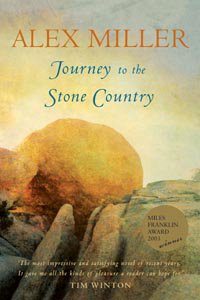
We spent four days in Bright last week, our usual sub-alpine summer holiday destination. This year we decided to stay in a cabin instead of camping, which was more expensive but less work. It wasn't quite the same however as you tend not to spend as much time out of doors. There was a fire ban on the first day of arrival but we did manage a nice campfire on the second night. I've got some nice pictures but for some reason I'm having trouble uploading them. I could, however upload the cover image of Alex Miller's Journey to the Stone Country winner of the 2003 Miles Franklin Award which segues nicely into my holiday reading report. Miller's novel, set in far North Queensland, functions as a kind of metaphor of the tenuous relationship between black and white Australians. Childhood friends Bo Renney of the Jangga tribe and Melbourne academic Annabelle Beck, recently returned to her ancestral home after a marriage bust-up, forge a new relationship based on a realistic view of their shared history. Once having stared into the face of the violence between their two families in the past they are able to set their sites on a possible shared future. The narrative drags a little in the middle section but the latter half of the book is particularly moving as both of the protagonists make discoveries about their past that force them to rearrange their present. I was attracted to the cover because I have always felt a kind of connection of some sort to monoliths. My friend Gerard Goldman at the Broken Bay Institute tells me it's part of my dreaming. Maybe so.

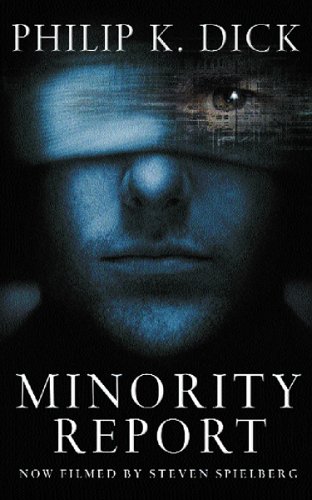
From the past to the future, I enjoyed a collection of science fiction short stories from Philip K. Dick under the title of Minority Report, no doubt to cash in on the Spielberg movie of the same name. I had read two of the stories already, the title story and "Second Variety" in another collection of stories loaned to Jesse by Jon Case - The Variable Man. Quite a few of Dick's stories, apart from "Minority Report," have been filmed. "We Can Remember it For You Wholesale" became Total Recall, "Do Androids Dream of Electric Sheep" became Ridley Scott's Blade Runner, "Paycheck" became John Woo's Paycheck, and "Second Variety," which Jesse and I thought would make a good short film, became Screamers written by Dan O'Bannon (he of Alien and Dark Star fame) - beaten to the punch again Jess. These are pretty engrossing stories. Some, like "Oh, to Be a Blobel," about a human who involuntarily tranforms into a blob-like creature, after having fought a battle with this species on the other side of the galaxy, seem like the prose equivalent of a Silver Age Marvel comic (not that there's anything wrong with that). Others like "The Electric Ant" are chilling meditations on the nature of identity - does a cyborg with programmed memories fear extinction if his memory tapes are arranged? If it does fear extinction it must have consciousness. Is it therefore a "person" with a "soul"? Science fiction writers are often credited with anticipating future technology. What strikes me about these stories however is how they fail on that point. These stories, written between 1953 and 1969, do not seem to have anticpated digital technology at all - everything is on tapes and computers are still huge devices housed in separate buildings!

Finally, I have almost completed a book my daughter Ellen recommended to me. First They Killed My Father: A Daughter of Cambodia Remembers by Loung Ung tells the horrific tale of the survival of a young Cambodian girl whose middle class educated family members are targetted by the Pol Pot regime as enemies of the state. It's a harrowing first-person account of one of the worst incidences of genocide from that most bloodthirsty of centuries - the 20th.


AddThis

Share |