Showing posts with label Trinity. Show all posts

Monday, November 20, 2006

Trinity and Mission (2)

Not THAT Trinity! How'd that get uploaded to my Blogger dashboard?

I received the following comment on The Trinity and Mission via email from Dr. Jon Case, Associate Professor of Theology at Houghton College, New York and thought I'd post it here.

"Think of the Trinity in doxological terms: Do you worship Jesus Christ? Do you worship God the Father? Do you worship, and pray to be filled with, the Holy Spirit?
If you answer yes to all of the above, then the question arises: just how many gods do you worship?

As a minimum, the doctrine of the Trinity attempts to maintain the tension that keeps you away from thinking of 3 gods and from thinking that Jesus, his Father and the Holy Spirit are not three distinct identities. If you say that they are not, then good luck to making sense of the NT. Father Son and Spirit interact with each other. Is that just a charade? If it is, then the text of the NT is no reliable guide to God.

Of course, if you answer 'no' to any of the above opening questions re Father, Son or Holy Spirit - you're in real trouble (and btw, you probably shouldn't be praying to be filled with a spirit that is not God's spirit).

If you answer: I just worship 'God' -and don't pay particular attention to the persons- then you have taken yourself right out of the pages of the NT. The earliest Christians worshipped Jesus --without denying worship to his Father-- by the infilling and power of the Holy Spirit. The worship came first - the theological precision followed a bit later.

If you say: 'Well of course I worship Father, Son and Holy Spirit and believe in only one God, but I don't want to use the term "Trinity" - let's use another term;' -- then in response I'd say you are showing poor theological judgement (a bit like trying to reinvent the wheel) and are needlessly causing confusion in the body of Christ.

So what difference does the doctrine of the Trinity make to mission? We are not calling people to merely follow Jesus (which by itself can be simply an ethical pursuit); we are calling them to worship Jesus. That activity, as the church has acknowledged, lands you in the middle of trinitarian considerations (in other words, just how many gods are we worshipping here?) And if you're not calling followers of Jesus to worship him, I'd say the whole idea of mission is in trouble."

The following was received by Dr. Mike Walters, Professor of Christian Ministries, at Houghton College:

"My daughter just had been asking me some questions about the Trinity for her cell group and I cobbled out a 3 page response...I'm very interested in the emergent church, for a number of reasons, but your response further down the page was appropriate. I once had a friend who left our mutual denomination (not the Wesleyans) who told me, "once the chicken leaves the egg, he/she then has to decide, "what will be my relationship to the shell? Will I disdain it as that which kept me bound, or will I gratefully acknowledge that it birthed me, protected and nurtured me, until I could walk on my own?"

Thanks for your comments guys.

Thursday, November 09, 2006

The Trinity and Mission

This is a continuation of the very lengthy discussion in the comments section of my blog entry An Open Letter to My Friends in the Emerging Church. If you want to follow that interesting discussion, start there first and then continue on here.

The Trinity is not just (as Chris puts it in the earlier comments section) "a very useful concept to understand what God's trying to tell us." The Trinity is God. Of course the doctrine of the Trinity is a construct of language and of the mind, but so is all speech and all thought. Anything we say about God is metaphorical, not just what we say about the Trinity. Nobody claims, least of all the Trintarian theologians of the Nicene era, that the human mind can fully comprehend the being of God. All is mystery to us except what has been revealed. In Luther's language the only God we see is the God who is clothed in Jesus Christ. But what the appearance of Jesus Christ drives us to inevitably is a God who is Triune. What the church confesses about the Triune nature of God is not something spun out of the air by rampant Hellenism. It was religion before it was theology. All formal theology has as its precedent the actual experience of God in the Christian community and in the world. It's not something begun in the rarified atmosphere of abstract thought (though it sometimes may end up there). That Trinitarian language (like all language about God) is limited is simply a given in all theological discourse. As Augustine put it, "When the question is asked, What three? human language labours altogether under great poverty of speech. The answer, however, is given, three ‘persons,’ not that it might be (completely) spoken, but that it might not be left (wholly) unspoken.” So it is a straw man argument to say that the Trinity is something not very important because no one can completely wrap his or head around it. To follow this line of reasoning would be to confess nothing about God at all, since we cannot do so comprehensively.

Chris says that my "fascination with [theology] is more academic than practical. Does knowing the trinity exists make you do your mission work better?" My response to the first part of the sentence is, brother, you couldn't be more wrong about that. My answer to the question about the Trinity and mission is a resounding "Yes." On the first point - Theology is a discrete academic discipline in many universities and other institutes of higher learning, yes. And though I teach theology in one such place, and am involved in the academic discourse of the discipline, my primary commitment to theology is as a Christian for whom it matters to think seriously about God. Theology is the business of every Christian, not just academics and professional theologians. Michael Jinkins helpfully reminds us that theology is reflection upon all of life, not just upon “religious” matters, when he says "Theology is the essential business of faithful reflection on human life lived consciously in the presence of God." (Invitation to Theology, 17.) Nothing could be more practical than this.

Now to the question, "Does knowing the trinity exists make you do your mission work better?" Absolutely it does yes. The most significant (re)discovery of twentieth century theologians was that God's existence as a "Being-in-Communion" (and not simply a divine Monad) is the fundamental beginning point of all Christian thought and action. This rediscovery of the Trinity as the beginning point of all theology and practice, beginning with Karl Barth, was the single most influential insight in the development of theology in a post-modern (please note the hyphen) world. Chris, as one who hopes one day to be a professor of theology, familiarity with this direction in theology should be of crucial importance to you. No-one hated philosophical theology more than Barth (with the possible exception of Luther), but he didn't find the Trinity in the philosophers. He found the Triune God in the Bible and inescapably in the Person of Jesus Christ. It is because God is in Godself a Being-in-relation, and we are made in the image of the Triune God, that we are called to reflect that same image in all of our interaction with others. We are called to be open to God and to others in outgoing, self-forgetting, love. The trinitarian relations within the Godhead whereby the Father gives his Son for the life of the world, the Son gives glory to his Father through unstinting, though costly obedience, and the Holy Spirit is given to glorify, not himself, but both the Father and the Son, provide the model for our relationships to others. Believers, in their relationships with one another, and with the world, are caught up into the “ecstatic” fellowship of the Divine Family. The believer is called to be one who shares with the Father, the Son, and the Holy Spirit, in an “others-focused” orientation. Surely this is the only proper foundation for mission.
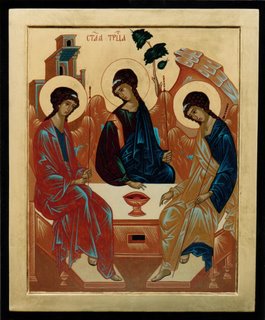
Modern Trinitarian theology has helped us to see that the doctrine of the Trinity begins with a focus, not on God’s ontological being, but on God’s saving activity. It centres on Christ’s birth, life, death, resurrection, ascension, and the gift of the Holy Spirit. The doctrine of the Trinity, rather than being a doctrine derived from philosophical reflection on the nature of Absolute Being (a reflection which always tilts toward sheer monotheism or monarchianism), is rather the result of rational reflection on the saving activity of God in Christ. These divine occurrences confront human reason with the realization that only a triune God can account for them.

Eric Macall wrote in Whatever Happened to the Human Mind (1980) : "The Trinity is not primarily a doctrine, any more than the Incarnation is primarily a doctrine. There is a doctrine about the Trinity, as there are doctrines about many other facts of existence, but if Christianity is true, the Trinity is not a doctrine, the Trinity is God. And the fact that God is Trinity - that in a profound and mysterious way, there are three divine Persons eternally united in one life of complete perfection and beatitude - is not a piece of gratuitous mystification, thrust by dictatorial clergymen, down the throats of an unwilling but helpless laity, and therefore to be accepted, if at all, with reluctance and discontent. It is the secret of God’s most intimate life and being, into which, in his infinite love and generosity, he has admitted us; and it is therefore to be accepted with amazed and exulted gratitude."

In the so-called postmodern world, it is more or less a given that individuals are not lone atoms but persons in relation. There is no longer any "autonomous man" (now a thankfully debunked modernist myth). Each person is who that person is because of intimate connections with other persons. The doctrine of the Trinity speaks profoundly to this realization, for it tells us that God’s own being is constituted in precisely this way - God is a being in communion. This communion is, moreover, a loving communion. As Robert Wilkin has it, “The doctrine of the Trinity reaches to the deepest recesses of the soul and helps us know the majesty of God’s presence and the mystery of his love. Love is the most authentic mark of the Christian life, and love among humans, as within God, requires community with others and a sharing of the deepest kind.”

After all, to which God are we introducing people when we engage in mission? Not Plato's Unmoved Mover, or the Absolute Monad of Arianism or of Universalism, but the God whose Name is Father, Son, and Holy Spirit. This is not some vague Higher Power or Supreme Being, but a Particular God - a God with a history. This is the God whose Name we all received at our Baptism, the God of Abraham, Isaac and Jacob (yes, and of Athanasius too), who brought our ancestors through the Red Sea, who transformed the world through the cross and the empty tomb. Chris says we can learn a lot from Buddhists and Mormons, and of course we need to be respectful listeners to all people. We cannot say we disagree until we can first say we understand and the church has not always been good at this. But what will happen if we lose the distinctiveness of the God we confess, what if we forget God's Name, what if we forget our Story, what will we have to offer in the dialogue? If emergent/missional churches are going to sit loose on the Trinity I truly fear for them.

Finally (if you've got this far you're probably one of the few), Chris thinks I'm mistaken when I say my church is "traditional" and that in fact we are "missional" but don't know it. I think we are using the word "traditional" in completely different senses (which is a very bad basis for dialogue). Chris, you seem to use it to mean something like this (correct me if I'm wrong) - "evangelical churches who are unfaithful to the Gospel because they are so consumed by running their own programmes that they are not engaged in mission beyond their own four walls." You see, to me there is nothing traditional about that at all. Some churches (of all kinds) are stuck in this pattern and some churches are not. I would suggest that far fewer are as dead in this respect as the emergent/missional churches claim. How then might I define my church as "traditional" and thus different from a typical emergent approach?

We believe that God calls us to gather together on the first day of each week in commemoration of the resurrection of Jesus Christ from the dead. It's not a sabbath - it's the Lord's Day - a mini-Easter every Sunday (or if you like every Easter is a Big Sunday). Emergent/missional churches don't think it's all that important on which day they meet or indeed if they meet weekly at all. Any day or time of the week will do; it's all the same to the Lord.

When we gather we enact a liturgy that narrates the story of what God has done in Christ. We enjoy preaching and we like it to be from the pulpit, a symbol, not of the minister's authority, but of the authority of Holy Scripture. We take up an offering each week because we think Christians should discipline their love of money and because we want to support and enable the church, including the pastor, in its ministry. We don't think it's absolutely necessary to sing hymns or any other kind of songs, but we embrace music (especially hymnody) gratefully and enthusiastically. Emergent/missional churches don't typically think too much of these patterns of worship, though some will do them. But worship is just as valid if it's meeting with a Christian friend down at the local cafe and having a talk about Jesus. We love to meet our friends at the cafe too but we wouldn't feel, like we had worshipped or "been to church." That's one of the things that makes us "traditional."

Like emergent/missional churches we wholeheartedly believe that ministry belongs to the whole people of God and that the church should do its utmost to equip and enable all of its members to fulfil their task in ministry. However, we still believe God calls men and women to a Ministry of Word, Sacrament, and Order - to have a shepherding responsibility over a Christian congregation. It would certainly be wrong for our pastors to big note themselves or lord it over their flocks, but we want to honour them and respect them as the Scriptures command us. We believe that a ministry of preaching, teaching, and pastoral care requires a high level of professional skill and knowledge development, so we want our ministerial candidates to have a degree in theology as well as whatever other specialised training helps them in their ministry. Just as we want the members of our congregation who are doctors, plumbers, or garbage collectors to give themsleves wholeheartedly to their life's vocation, to be recompensed fairly for their labours and to have safe and just workplace conditions, so we want our pastors to have the same. In keeping with this, a large proportion of our budget goes to pastoral support and we are unapologetic about this. This makes us "traditional." Emergent/missional churches tend to frown on professional clergy as a waste of money and resources and feel (again correct me if I'm wrong) that the system obscures the priesthood and ministry of all believers, so that the pastor does all the work and nobody else does anything. It's okay to operate without paid pastors of course, but it cannot be the only way. We (and millions like us) are happy with the traditional model of pastoral supply and apparently still reasonably "missional" as well.

To me "traditional" just means doing things pretty much the way the church has always done it, and "emergent" means trying something different. By that definition our congregation is "traditional" and emergent churches are not. One can be just as effective in mission as another.

Friday, June 23, 2006

Sermon for Trinity Sunday (11 June 2006)


Text: Isaiah 6:1-8

In a year of national crisis for Israel, at the death of King Uzziah, the prophet Isaiah was given a transforming vision of the majesty of the Triune God. It was a dazzling vision of splendour too great for any human eye to really take in, but in those weak and faltering symbols which we call words, he tried to describe what he saw. The Lord sat on his throne high and lifted up in regal majesty, angels flew and sang the praises of God. The Lord was so holy that even the angels, whom you would have thought were used to being in God’s presence, even those pure and heavenly beings, covered their eyes as they sang his praises.

The whole place shook as they sang, the structural soundness of heaven itself was threatened as the very doorposts and thresholds shook in the presence of God. Here was no tame or domesticated god, like the gods of the nations, who could be housed in little shrines or carried around in the pocket and set up at a makeshift altar of prayer along the wayside. This was the Lord high and exalted, and there is no God like him. He reigns in majesty. No wonder Isaiah trembled in fear. "Woe to me!" [he] cried. "I am ruined! For I am a man of unclean lips, and I live among a people of unclean lips, and my eyes have seen the King, the LORD Almighty."

Isaiah was keenly aware of his own personal sin and also of the corporate sin of his people. As an Israelite he knew that no man or woman could look upon the Lord and live. As Reginald Heber’s hymn states, “the eye of sinful man your glory may not see.” Isaiah felt for sure that he was a goner. In searching for a cultural parallel to this I thought of the phenomenon of alien abduction. Many people claim to have been abducted by aliens from other planets, subjected to all kinds of examinations and experiments and then returned to the earth carrying the psychological, if not the physical, scars of their terrifying experience. Now, I am not saying that these experiences are real, but let me just ask you to imagine yourself into such an experience. You are going along in your usual workaday routine perhaps travelling somewhere and suddenly you are struck by a flash of blinding light. The earth shakes as a strange craft emitting eerie noises descends upon you and an alien creature the like of which your imagination could never have begun to conceive reaches out to you and it is clear that it means to take you as its captive. I’m not talking about a cute little cuddly ET either, but one mean alien monster with who knows what murderous intention on its mind. Now tell me you wouldn’t be scared out of your wits.

Something like this must have been Isaiah’s experience. He didn’t just sit back and enjoy a vision of God in the way that we might sit back and meditatively reflect on an icon or a Rembrandt portrait of Christ, or Michelangelo’s Sistine Chapel ceiling. No, this was a vision which scared the living daylight out of him and in the light of which he could only cry, “Woe to me! I am ruined! For I am a man of unclean lips, and I live among a people of unclean lips, and my eyes have seen the King, the LORD Almighty.”

As an Israelite, Isaiah well knew the law that no one could expect to look upon the Lord and live. The light of God was so brilliant that no mortal could endure the sight of it. While we were in New Zealand recently we visited the glow-worm caves in the Bay of Islands. Our guide took us into the bowels of the earth and told us of how the glow worms emit their light so that at night unsuspecting insects fly into the cave attracted by the light never to return. Glow worms are arachnids (like spiders) which means they spin webs to trap their victims. Once the bug has flown toward the light it is caught in the web and the glow worm can then feast on it. This has gone on for who knows how many hundreds of thousands of years and the bugs never wake up to what’s going on, much to the benefit of the glow worm population. Isaiah was like a moth to a flame, trapped in a web from which there could be no return expecting to be devoured on the spot by the awesome majesty of the Triune God.

When Isaiah refers to the unclean lips of himself and his people the lips are serving as a symbol for the whole of the sinful human nature. In chapter 1 of his prophecy, verses 4-6, he had bemoaned the universal nature of sin’s power. “Ah, sinful nation, a people loaded with guilt, a brood of evildoers, children given to corruption! They have forsaken the LORD; they have spurned the Holy One of Israel and turned their backs on him. Why should you be beaten anymore? Why do you persist in rebellion? Your whole head is injured, your whole heart afflicted. From the sole of your foot to the top of your head there is no soundness - only wounds and welts and open sores, not cleansed or bandaged or soothed with oil.” (Isaiah 1:4-6)

Perhaps it is significant that Isaiah chooses the lips as a symbol for the sinful human nature, for as a prophet it was with his lips that he was supposed to serve God and with his lips that he had failed God. What do we do when we discover that our best attributes, the God given talents with which we have been blessed instead of being used to bless our neighbours and glorify God have been used instead for sin, have been twisted by our own selfish desires and motives? What do we do when we realise that all around us are in the same situation? That we are sinners and that we dwell among sinners? What can we do except what Isaiah did? Call out “Woe to me! I am ruined!”

Where is the Gospel this Trinity Sunday? Where is the good news in Isaiah? Well, here it comes in verses 6 and 7. "Then one of the seraphs flew to me with a live coal in his hand, which he had taken with tongs from the altar. With it he touched my mouth and said, “See, this has touched your lips; your guilt is taken away and your sin atoned for.” The Father’s majestic glory might hide from us his grace and compassion but the Son has come to make atonement for our sins and to open up a way back to God. He came as the friend of sinners. We don’t just worship a God “immortal, invisible, God only wise, in light inaccessible hid from our eyes.” We worship the Son who said, “I am the light of the world” - not a light against the world that consumes all in its path - but a light for the world, which shines a light on the pathway back to God.

Isaiah got the opposite of what he was expecting to get. He thought for sure that fire was going to come out from the altar and consume him on the spot leaving just a smudge where the great prophet once had stood! Instead the fire that he thought would consume him, took away his guilt and atoned for his sins. He got exactly the opposite of what he was expecting. Self righteous people, especially the religious sort, get the same - the exact opposite of what they expect. Some people spend their lives congratulating themselves for having avoided the more socially unacceptable, cruder, forms of sin, and for doing so much good for their neighbours in supporting worthy causes of various sorts. They really feel that God should count himself lucky to have them on his side. After all they bring so many talents and resources into the church for God to use. They fully expect a hearty pat on the back when they stand before the Lord to give an account for their lives. How shocked some will be when they hear instead the words, “Depart from me; I never knew you”! "And these shall go away," said Jesus, "into the fire prepared for them. " Yes, fire consumes but it also purifies. It depends very much on the timing of the application! Jesus said he would baptise with the Holy Spirit and with fire. Here a hot coal is removed from the altar and placed on Isaiah’s lips, the organ of the faculty of speech which he saw as the location of his problem was touched and purified, reminding us that in whatever areas we may have sinned, God’s purifying work can reach them and transform them through the atoning work of Christ.

The Triune God reigns in majesty; he cannot be seen through the eye of sinful humanity. But it is this same God who atones for sin, and who calls us into his service. Not only does Isaiah find that his guilt is removed and his sin atoned for, he is also given useful work to do for God, as we read in verse 8, “Then I heard the voice of the Lord saying, "Whom shall I send? And who will go for us?" And I said, "Here am I. Send me!"

During the recent Wesleyan Convention in New Zealand, I attended a seminar on discerning God’s call to ministry. The facilitator asked four individuals who were now ordained ministers to share with the group their own testimony. She also asked us to see if there were any common elements shared in each person’s individual story. One thing I noted was that each felt inadequate and unqualified when God first called them. God had to keep working on them until almost against their wills they entered the ministry knowing that only in this way could they follow God’s call on their lives. And aren’t you glad that it is that way? Otherwise the ranks of the church’s leadership would be filled with self confident blustering, arrogant people who feel fully equipped for all that life and ministry might throw in their direction! (As it is we only have a few such people in the ministry.)

The Father’s majestic glory is seen in the Son who opens up a way through his shed blood for us to be purified from our sin. But if we are going to serve God acceptably we are going to need the Holy Spirit - the life of God himself who enables us to accomplish the work he gives each of us to do. If we are going to be able to say ‘Here am I; send me” we are going to need more than morality, more than religion, more than idealism. We will need the life of God himself imparted to us as an indwelling , personal presence. And this is what we have in the Person of the Holy Spirit. The Father sends the Son, the Son dies and rises again to provide forgiveness, and the Spirit proceeds from the Father and the Son to empower us to live the Christian life. You see, the Trinity is not just some philosophical speculation. The Trinity is God, and there is no Gospel, no good news, unless God is Father, Son, and Holy Spirit. As the theologian Robert Jenson has said, the Trinity is not a theological puzzle but the key that unlocks all the other theological puzzles. Glory be to the Father, and to the Son, and to the Holy Ghost, as it was in the beginning, now is, and will be forever, world without end. Amen!

AddThis

Share |