My rating: 4 of 5 stars
This book, along with Wigger's more recent biography of Francis Asbury, is American Methodist history at its finest. Tracing Methodism's emergence and development until the mid-nineteenth century it provides a thoroughly researched and eminently readable account. It's all here - the circuit riders, the itinerancy, camp meetings and their 'boiling hot religion,' slavery, and an excellent chapter on women in Methodism. The Methodist 'croakers' who decried the decline of the movement from about the 1820s were not concerned about statistical decline (with a few slumps Methodists growth continued to meet or exceed aggregate national population growth until the 1950s) but about decline in spiritual fervour. From the first decade of the nineteenth century Nathan Bangs argued that Methodism was right to enter into the mainstream of American life and laboured to this end, in an ironic twist claiming that his cause came to him in a prophetic dream. But Peter Cartwright and many other aged itinerants mourned in their published memoirs the loss of an earlier frontier experience. One of the great religioous dramas of the modern era, the story of American Methodism continues to fascinate and enthrall. Anyone serious about the study of American Methodism will already have read this book. Those who are yet to discover it are in for a treat.
View all my reviews
Tuesday, September 18, 2012

Friday, December 24, 2010
Workshop on the History of Australian Methodism

On 3 December 2010 the first of a series of Workshops was held at Wesley College, University of Melbourne, on the History of Australian Methodism. The project is funded in part by an ARC grant and is co-convened by Professor Hilary Carey, Dr. Troy Duncan (both of the University of Newcastle) and myself. Three Conferences will beheld in all - in Sydney, Melbourne and Adelaide - and it is hoped that a new published history of Australian Methodism will result.Those in the photo taken in the Wesley dining hall are from left Hilary Carey, Robert Linder, Troy Duncan, Stuart Piggin, Glen O'Brien, Ian Breward, William Emilsen, Daryl Lightfoot, Brian Howe, Jennifer Clark, Renate Howe, Barry Brown. Not pictured - Garry Trompf, Marion Maddox, David Roberts.
Tuesday, June 08, 2010
Anti-Americanism and the Wesleyan-Holiness Churches in Australia


My journal article on "Anti-Americanism and the Wesleyan-Holiness Churches in Australia" in the Journal of Ecclesiastical History has finally arrived on my desk in hard copy. JEH are also making the article available in a free download from this "deep link" for those who may be interested in reading it.
Friday, February 05, 2010
Reform and Conflict
 Rudolph W. Heinze, Reform and Conflict: From the Medieval World to the Wars of Religion (Oxford: Monarch, 2006) is an excellent one volume introduction to the Reformation period, suitable for a college level text. In fact I will use it as such the next time I teach "The Reformers and the Reformation" at Booth College. It's long reformation extends from 1350-1648, nicely framing the central events in a larger context. The work of revisionist historians is taken seriously but Heinze also wants his readers to understand and appreciate the insights of older historians and the importance of their work. One of the most helpful aspects of Heinze's book is his discussion in chapter 11 of women in the Reformation period including interesting discussions of Wibrandis Rosenblatt, pictured above (who was married three times including to both Oecalampadius and Martin Bucer), the Strasbourg reformer Katherine Zell, and the Catholic reformer Vittoria Colonna.
The Monarch History of the Church (Baker History in the US) is an outstanding multi-volume series, and this is the third of the four volumes appearing so far that I have read. Each one delivers in terms of avoiding too much technical discussion but at the same time introducing the reader to recent scholarship on key issues in dispute. The books are attractive and inexpensive (you can opt for the hardback or paperback editions), and include helpful timelines and suggestions for further reading after each chapter. Four out of five stars from me.
B.J. Kidd, The Counter-Reformation. London: SPCK, 1958.
 Arnold Toynbee once derided those historians who think that “history is just one damned thing after another.” They may have had Kidd’s book on the Counter-Reformation in mind. Light on any kind of historical analysis, this is essentially a chronology of significant events in the movement to turn back the tide of Protestantism in Europe in the second half of the sixteenth century. As one might expect, the Jesuits, the Roman Inquisition and the Council of Trent figure prominently, each being given a chapter of its own (the Jesuits in fact get two chapters). Other than these thematic chapters (and a few others) the rest of the material is arranged on a more or less geographical plan, beginning with Italy and Spain, and extending as far as Britain, the Netherlands and the Baltic states. Germany of course figures prominently.
The first edition of this work appeared in 1933 so naturally a study of the Counter-Reformation would need to be supplemented by more recent works such as John O’Malley’s Trent and All That (Cambridge: Cambridge University Press, 2000) or Martin Jones, The Counter Reformation (Cambridge: Cambridge University Press, 1995). Even an older work such as A.G. Dickens’ The Counter Reformation (New York: Harcourt Brace, 1969) will yield a lot more reading pleasure than Kidd whose tone is for the most part a dry recitation of events.
Though Kidd is dry I would not say he is impartial. Warden of Keble College, and canon of Christ Church at the time of this edition’s publication I read the SPCK edition of 1958 not the 1980 reprint by Greenwood Press), his disdain for the fracturing tendencies among Protestants is thinly veiled, and there are one or two passages where he almost becomes interesting in praising the beauty and resilience of Catholic resurgence. It is more than a little frustrating that not until a footnote on the very last page of the book (p. 262, fn. 4) does he provide a definition of the word “Protestant,” and when it comes it is very narrow (though historically accurate enough). “Protestant” to Kidd means only “Lutheran” and “Reformed” means “Calvinist.” This is fair enough, but what is really interesting is the brief excursus he provides in the same footnote into the nature of his own Church of England, which he is keen to insist is neither “Protestant” nor “Reformed.” He cites the decision of the bishops at the Savoy Conference in 1660 to reject the term “Protestant” and the insistence, in 1689, of the Lower House of Convocation that the Church of England could not be termed Protestant without associating it with Socinians, Baptists and Quakers (!). Clearly Kidd was one of those Anglicans for whom the very Protestant (and perhaps even “Reformed’) Thirty-Nine Articles could only be likened to the “forty stripes minus one” received by Paul.
The book’s most interesting chapter for me (also its longest) was chapter 4 on the Council of Trent. A helpful summary of important decisions of the Council is given and the way in which different visions of Catholic reform were set forth provides an interesting record. It would be the reforming zeal of Pope Pius IV that would be the most determinative factor and Trent is really his most important legacy. His successor Pius V continued in a similar vein with a special zeal for the repression of heresy. It was the insistence on an educated, literate and articulate clergy, and the establishing of universities and seminaries in order to bring this about, that did more than any other single initiative to promote genuine reform of the Church. Chapters 6 and 8 on “The Great Powers” and “The Forces behind the Revival” make it clear that there could be no reforms without the willing participation of the princes (especially in light of the established rule cuius regio, eius religio) and the special genius of religious thinkers and activists with a passion for organisation. Ignatius Loyola was only the most conspicuous of the latter, whose ranks included others such as Charles Borromeo, Robert Bellarmine, and the earlier mentioned Popes Pius IV and V. In case the reader should think that religious reforms are solely the result of the prayers and labours of the saints, Kidd wisely reminds us that behind the reform stood also Phillip II of Spain’s “great scheme to crush out Protestantism in Europe.” (p. 160)
Those wanting an introduction to this period should probably not begin here. But those who are already somewhat familiar with the lay of the land, and who are looking for a detailed chronology, could do worse. Two and a half stars.

Monday, November 30, 2009
The Reformation and the English People
 This is one of the earliest of the revisionist accounts of the English Reformation. It helpfully states its central thesis in its second sentence: "On the whole, English men and women did not want the Reformation and most of them were slow to accept it when it came," a contention confirmed and built upon by others since, most notably Christopher Haigh, Eamon Dufy and Diarmaid MacCulloch. Instead of the traditional account of a disgruntled layfolk, sick and tired of "priestcraft" and superstition calling for reform, we have instead a picture of a thriving late-medieval Catholic piety among a laity, having enforced upon it an unwelcome reform from Protestant-minded bishops and statesmen. Scarisbrick's work is thoroughly researched and his findings now entering the mainstream of opinion. Contrary to the view that Luther's doctrine of the "priesthood of all believers" gave rise to a literate, liberated laity, Scarisbrick argues that the loss of the medieval lay fraternities left lay people with less self-determination and less of a role to play in their religion. The English Reformation led to "a marked shift in the balance of power in favour of the clergy...The new Protestant minister, if he was a zealous servant of the Gospel, was a disciplining, preaching authority-figure. He may not have had the sacramental powers of the old priest, but he expected rank-and-file lay people to be more passive..." (p. 39) Balancing this is the massive transfer of ecclesiastical lands into the hands of the laity through the loss of religious houses with the dissolution of the monasteries. An incident recounted on p. 108 serves as something of a metaphor for the reluctance of some English Christians of the sixteenth century to embrace the iconoclasm of Protestant worship. In 1569 at Durham as a high altar stone was being hidden in a rubbish heap to be recovered when things swung back to conditions more favourable to Catholic worship, one of the ringleaders was heard to address the stone "Domnius vobiscum (The Lord be with you)." In such ways did English Catholic laity of the period come to terms with the new order.

Wednesday, October 14, 2009
Review of Gordon Rupp, The Old Reformation and the New

Gordon Rupp, The Old Reformation and the New: The Cato Lecture for 1966 (London: Epworth, 1967)
I love a book of good lectures now and then because it's not weighed down by too much detailed scholarly analysis. Originating as spoken presentations to a live audience they give scholars (and Rupp was an outstanding Reformation scholar) an opportunity to get into free style mode. When such reflections are based on a lifetime of scholarly activity, the peppering of anecdotes and well chosen aphorisms are a delight to read. Rupp was one of the greatest Luther scholars of his day and a Methodist to boot! (His 1947 Lectures on "The Righteousness of God" constitute a classic in the field.) This slim little volume reflects on the nature of the twentieth century as an Age of Revolution, examines the revolutionary impact of the sixteenth century Reformation (as a Crisis of the Word, a Crisis of Communication, and Crisis of Compassion) and then brings some words of sage advice to those engaged in the "New Reformation" of theological revisionism. He has little patience for innovators such as the Bishop of Woolwich, John AT Robinson, who compared himself with Martin Luther. "I wish him well," says Rupp. "He has now only to be unfrocked, tried and condemned for high treason, to write four of the world's classics, to translate the Bible and compose a hymn book, and to write some 100 folio volumes which 400 years hence will concern scholars all over the world, and to become the spiritual father of some thousands of millions of Christians - to qualify as the Martin Luther of a New Reformation." (p. 51) Rupp has no aversion to contemporary constructions of the faith but has only scorn for superficial mass media treatments that offer the same "baloon-like inflation" to theology and liturgy as are given to the Beatles and James Bond! (ibid) Though he has admiration for Bonhoeffer and his "religionless Christianity" he is not willing to "unchurch the Church" or "unpeople the people of God." "Once we admit that God has called us not because of our virtue or wisdom or efficiency - the ability to be up-to-date and impressive or exciting or brilliant - but simply because in His mercy he has pitied us, then we have another measure for the life and death and reformation of the Church." (p. 64). There is something here for contemporary missional and emergent thinkers who often speak as though the church is a hindrance rather than a help in engaging in mission and can even speak of being "post-church." Augustine, Luther, Newman, and Bonhoeffer (Rupp reminds us) were not only "incurably religious men, but professional religious men." (p. 64) That is, they were clergy - professional church leaders. Even Bonhoeffer with his secular Christianity was consumed with zeal for the house of the Lord. Rupp was convinced that there could be no genuine renewal of the Church in his time without the same kind of prophetic voices. The same remains true today.

Friday, February 29, 2008
On Burning Heretics
 I've been reading any interesting post by Stumac over on In the Moment about the bad behaviour associated with battles over theology. I think we find this kind of thing so hard to deal with partly because we view heresy so differently from the ancestors. We tend to see it as an intellectual infirmity - the person isn't thinking straight. They, on the other hand, saw it as a moral fault - the willingness to believe a lie. Actually the New Testament seems to assume this pre-modern concept. It's interesting to note that in the Book of Revelation it is not only the false prophet who is thrown into the lake of fire but also "all those deceived by him." Hang on isn't being deceived something amoral, something "not my fault"? Perhaps not; perhaps I allow myself to be deceived because of some inner fault that is willing to believe a lie.
The other difference between us and earlier generations of Christians is that because religion was previously so much a part of society (especially from the late medieval/early modern period) a heretic threatened the very stability of the social order. Today a heretic can hold whatever false doctrines he or she wants and it doesn't bother us at all because we live in a free and liberal society, in a world of complete freedom of religion. Every suburban Kingdom Hall is evidence that this system works very well. But to a person in, say, Luther's Germany, a heretic such as Michael Servetus (just as an example) was considered not unlike the way we might consider a terrorist - a person whose view threatened the safety of society and who needed to be prosecuted for his religious views for the good of the whole.
Now, I am not trying to make excuses for the atrocious act of burning and torturing heretics. It was as unChristian then as it would be today. But understanding these people's context and the way they acted as people of their time helps us understand a little better the actions they took (even if we still believe they were wrong). I'm glad we no longer burn heretics - these days we make them bishops.
Friday, July 13, 2007
Protestant Icon 2
 Here is my second Protestant icon - this one a kind of ascension portrait -"The Apotheosis of John Wesley " from the Methodist collection of the John Rylands Library at the University of Manchester. "Blessed in the sight of the Lord is the death of his saints."
Protestant Icon 1
 Orthodox and Catholic Christians have plenty of icons both metaphorical and actual. We Protestants tend to settle on metaphoric icons only. If we were to write icons who might we include? This is "Martin Luther King of Georgia" by Br. Robert Lentz, OFM, ©1984. The text reads "How long shall justice be crucified and truth buried?" Tell me who you think deserves to be an icon.
Friday, July 06, 2007
Earn, Save, and Give
 The following e-advertisement received from my denominational headquarters is a bit rich (pardon the pun)!
Earn, Save, and Give at WIF! If John Wesley were with us today, we imagine he would be an investor at Wesleyan Investment Foundation. His admonishment to "Earn all you can, save all you can, give all you can" is about Serving Higher Interests! When you save with WIF, your money earns up to *6.0% *and helps churches. Request an investment packet today by calling WIF at 317.774.7300 or e-mailing us at info@wifonline.com
Imagine away my freids at WIF. I think I can say with a fair degree of certainty that John Wesley would not invest in the Wesleyan Investment Foundation (WIF) if he were alive today. The idea of investing money at interest was anathema to him. People forget it was the give part of his motto that was its real point. Wesley could have become a wealthy man on the strength of his publishing ventures alone, but he stayed on a very meager income his whole life. Whatever extra he earned he gave to the poor, because he believed it a sin to have any money or goods while others lacked food, clothing and shelter. He never owned a house, but lived in bedsitters attached to chapels in London and Bristol and slept in other people's houses as he travelled. He never accumulated any savings, and when he died he left behind him a saddle and a few books - oh yes, and Methodism. You can read his sermon on The Use of Money here.
Don't get me wrong. I'm not saying you shouldn't invest in WIF. If you're going to invest your money it makes sense to invest it where it might do some good for the church (though I would want first to ensure that WIF is committed only to ethical investments). I'm not speaking here as a moralist or as an ethicist but as an historian. Whatever you or I decide to do with our money it is certain that Wesley would not have invested it in WIF or anywhere else. He had none to invest becasue he felt it was his obligation to give it all away.
Monday, April 02, 2007
Revisiting Hellenism
 One of my Kingsley students has entered the following interesting comment on the Intro to Theology blog.
This week I have been reading ‘The Shaping of Things to Come’ by Michael Frost and Alan Hirsch, anyone read it? On pages 119-123, the authors present an interesting discussion on the topic of Hebrew and Hellenistic thinking in early Christian doctrines and their impact upon Christendom throughout the History of the Church. I have found the authors comments to be interesting and am keen to hear anyone’s comments in response to what they have to say. In summery, they argue that early Christian doctrine and thinking, including the creeds were largely and inappropriately influenced by Hellenistic thinking; an imbalance which could have been avoided had the early church fathers stuck to a more ‘Hebraic Spirit’ when interpreting scripture and discussing Christian dogma. They also perceive that when discussing Christology, early theologians focused too much on speculative doctrines, topics such as the Trinity, rather than ‘…the very elements that are stressed in scripture; ethics, discipleship, life and mission…[while also there being] no mention at all of Jesus the revolutionary, the subversive, the activist.’ As you have been reading through theology this semester, what do you think? Too much speculative theology, not enough practical? If so, has this had a profound impact of Christendom? In ‘Christian Theology, an Introduction’ on page 276, the ‘History of Dogma’ is introduced in relation to the topic of a suffering God. In this case, recent theologians seem to have altered their theology on this topic due to them having discovered an inappropriate leaning toward Greek Philosophy by earlier Christian theologians. Is there a danger of the same being the case in numerous other topics of Christian theology? I suppose, in view of Church history and theology, such questions have been the very heart of those who have gone before. Thomas Aquinas, an advocate for Greek philosophy, and Tertullian of Carthage, a strong advocate against the merging of theology and philosophy would be examples of this. Maybe I’m asking questions that too big for our little theology class. None the less, I feel it doesn’t hurt to ask and ponder.
Here is my reply: Certainly we need to be careful that we don’t allow our theology to be unduly influenced by philosophy (Hellenistic or otherwise) and the example you gave about the rediscovery by contemporary theologians of a suffering God is an excellent case in point. However the simplistic Hebraism good/Hellenism bad typology can be pushed too far. After all, the New Testament itself was written in Greek and the Old Testament Bible of Jesus and the Apostles was the Greek Septuagint translation, a product of Hellenised Judaism.
According to Cyril C. Richardson, “It was the Greek, rather than the Jew, who became the inheritor of the Christian message - a fact which should give pause to those who unduly exaggerate the importance of Hebrew over Greek thinking.” Christianity both inherited and displaced the older Greek philosophical system. When the Christian Emperor Justinian closed the philosophical school in Athens in 529 it was in one sense a sign of the victory of Christian theology over earlier modes of thought, but also a sign that the older views were no longer captivating the human heart and mind. Pelikan reminds us that the closing of the school was “more the act of a coroner than an executioner.”
Yet this “victory” over Greek philosophy was not complete “for the theology that triumphed over Greek philosophy has continued to be shaped ever since by the language and the thought of classical metaphysics.” A good example of this is the medieval doctrine of transubstantiation with its reliance on Aristotle’s distinctions between “substance” and “accidence.” The so-called “Hellenization” of Christianity continues to be viewed as a subversion of genuine Christian teaching. This may be too simplistic but it remains true that in struggling to overcome pagan thought Christian thinkers often accommodated its terms in such a way that a high price was paid. Clement of Alexandria, for example, was heavily influenced by Middle Platonism. Even Tertullian, who asked what Jerusalem had to do with Athens, applied philosophical categories in his very attempt to distance himself from philosophy! The continuing influence of Greek philosophy on Christian theology is evidenced in part by the latter’s keen interest on the twin themes of the “absoluteness of God” and the immortality of the soul. Christian theologians typically asserted the Greek concept of the impassibility of God (his inability to experience feelings) as a given without providing much biblical proof for the idea, a concept which, as you have pointed out, has come under increasing attack in more recent theology.
Still, we should not press this “Hellenization” theory too far as if Christianity were not making an entirely new contribution or did not have its own unique voice. Chadwick comments on the paradox of Clement of Alexandria being “Hellenized to the core of his being, yet unreserved in his adhesion to the church.” The Fathers very often modified Greek philosophical ideas in light of Scripture. Indeed, Pelikan has argued that the theology of the creeds may well be seen a result of the “dehellenization” of earlier errors and that the real place to find Hellenism is among the heretics!
It could also be argued that Hellenized Christians were living in a Greek-speaking, Greek-thinking culture, so that Hellenising its message was simpy being missional! They utilized the thought forms of the very air that the church was breathing, in order to speak the truth of the gospel to a watching world. Indeed, it could be argued that if the church had failed effectively to Hellenize its message it would have remained a Jewish sect, exerting little influence on the surrounding world.
Friday, March 30, 2007
The Constantinian Christendom Myth

Many popular books on church renewal perpetuate the myth that the early church worshipped in homes in a simple non-ritualized style much like the house churches of today, and that things began to go terribly wrong when the emperor Constantine was converted to Christianity and adopted a “Christendom” model of church-state alliance. The problem with all of this is that the scholarship on the early church doesn’t really bear this explanation out. The early Christians borrowed the pattern of Jewish synagogue worship, with its simple public ritual of prayer, praise, singing (or chanting) and scripture reading and exhortation, and then added its distinctively Christian content, most uniquely the Eucharist. Though many people today tell us that “we need to get back to worshipping the way the early church did” one is struck by reading accounts of worship in the first few centuries with how very similar it all seems to what still takes place in the typical suburban church in today’s world. In addition to the elements alrready listed above, an offering was taken, and there are words of greeting to commence and blessing to conclude the service, all of which is being overseen by an “up-front” leader. The degree of continuity found in these elements across time is quite striking.
It is true that the early Christians often met in homes, and the house church movement of today sees this as a worthy pattern to be followed. There is certainly nothing wrong with meeting in homes and it may well be a preferred mode of gathering in certain situations. However, it should be noted that meeting in homes was a practical matter for the early Christians, not a theological one. Until they could be sure that they would not be subjected to further imperial persecution they needed to meet discreetly in private. Often the homes in which they met were the homes of wealthy members of the Christian community who had large enough rooms to accommodate crowds. Archaeological finds have uncovered evidence of the demolition of walls to create auditorium-like spaces within these homes. So the space within an early Christian “house church” functioned much more like that in a typical suburban church today than a “house church” meeting marked by informality and a relaxed “homey” atmosphere. (One major difference is that there were no pews. Not until much later did churches begin installing pews. People stood throughout the entire liturgy, and this is still the practice in most Orthodox churches today). Once the state gave them freedom to build their own public meeting halls they quickly adopted the Roman basillica model and went public.
Many writers of popular books on church renewal continue to perpetuate the myth that the age of “Christendom” begins with the conversion of Constantine in 312 AD. Poor old Con gets the blame for a great deal of things he probably wasn’t responsible for! He’s a favourite whipping boy of the Adventists who say he invented Sunday worship which is nonsense since Christians had worshipped on Sunday since the day Jesus rose from the dead. Constantine gave Christianity legal status but he did not create a “Christian Empire” - though he dreamed of it. It was Theodosius I (emperor from 379-395), not Constantine, who first made Christianity the official religion of the Roman Empire. Even then this by no means meant that the church had a monopoly on the late antique world of the first few centuries. Constantine simply gave Christians legal status alongside of other religions including the old Roman paganism. If by “Christendom” we mean a situation in which the church and state are closely aligned and the church completely dominates society, we really do not see this prevailing until 700 years or so AFTER Constantine - at the height of the Medieval period. For centuries before that was accomplished, the church existed in a cosmopolitan world of religious ideas much like our own, without special privileges or carte blanche state sanction. Even cities we think of as Christian centres, such as Antioch, Rome, and Constantinople, were by no means fully Christianized, as Christian bishops charged with the task of evangelising them knew all too well. Once barbarian tribes such as Goths, Vandals and Huns began to impinge upon and ultimately invade and conquer the Empire, the church was on the backfoot again. It had a good amount of success converting the barbarians - a missional activity if ever there was one - (though the Arians seemed to fare better than the Orthodox on this score), but you can be assured the church often had a very tenuous hold on the populace of any given urban area for at least the first thousand years of its existence. Hardly the Christendom model. If nothing else, all this demonstrates is that people who write books on what the church should be in the future need to seriously engage with people who write books on what the church actually has been in the past so that popular myths are not perpetuated.
Wednesday, October 18, 2006
Quote of the Week
 "Postmodernism, at least as applied to history, is an intellectual dead end which will one day be equated with pseudo-sciences such as phrenology ["reading" the bumps on people's heads] in the early nineteenth century and the study of the paranormal later...[It] will be seen - sooner one hopes rather than later - for an 'emperor's clothes' phenomenon, and...there will be wonderment that so many clever people wrote, believed, and applauded so much manifest nonsense, and were promoted for doing so; and that it it inspired the writing of so much ugly, pretentious, jargon-ridden English."
- R. M. Thomson reviewing K. Ashley and P. Sheingorn, Writing Faith: Text, Sign and History in the Miracles of Sainte Foy, Chicago: University of Chicago Press, 1999 in The Journal of Religious History 30:3 (October 2006): 375.
The same issue of the JRH has an excellent article by Joanna Cruickshank, "Appear as Crucified For Me: Sight, Suffering, and Spiritual Transformation in the Hymns of Charles Wesley," of which you can read an abstract here. For a lengthier synposis you can visit the August 1st entry on Joanna's blog.
Wednesday, October 11, 2006
Ned Kelly and the Wesleyan Preacher
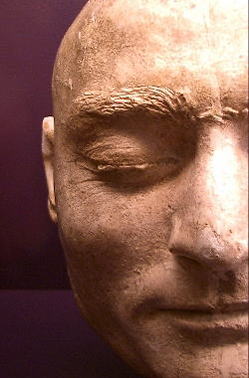 At left is a remarkable image of the death mask made from Ned Kelly's actual features and displayed at the wax museum in Bourke St in 1880. This is from the interesting Kelly archaeology site Two Huts
A little known story of Ned Kelly is his death row encounter with the Wesleyan preacher John Cowley Coles. The story is told in the generously titled book The Life and Christian Experience of John Cowley Coles Giving the History of Twenty-seven Years of Evangelistic Work in the Colony of Victoria, Australia and elsewhere, principally in connection with the Wesleyan Methodist Church, also chapters on the doctrine of entire sanctification and the enduement of power, with an account of the social conditions and mode of life of the diggers in the early days of gold digging in the same colony, written (at the request of many of his friends) by himself (London: Marshall Brothers and Melbourne: M. L. Hutchinson, 1893). Boy, they really liked long book titles in those days! Coles held services for the inmates of the Melbourne Gaol and members of his Band meeting were keen to know if he would be visiting Kelly. He applied to the governor of the gaol “as representing a Christian Church” but the governor said, “No, Kelly is a Catholic and has his own minister.” Not to be put off so easily Coles and his Methodist friends prayed that “the Lord would open the cell door” in order that he might “enter and see Kelly, in order to talk with him about his soul.”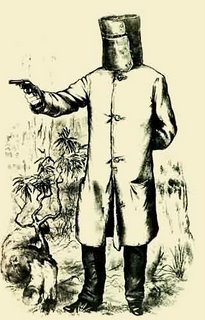 Soon after at the conclusion of one of the prison services, a warder approached Coles and asked if he would like to see Kelly. He said he would but that the governor would not allow it. The warder told him there was a regulation that any prisoner who requested it could see the minister who had been conducting the service. The warder went to see if Kelly wanted to speak with Coles and was told that he did and that he had heard every word of the service from his prison cell. Here is the fascinating description Coles gives of Kelly. "This man by no means looked a ruffian. He had rather a pleasant expression of countenance. He was one of the most powerfully built and finest men that I ever saw. He treated me with great respect, listened to all I had to say, and knelt down by my side when I prayed."
As for Coles’ ministry approach to Kelly here is how he describes his advice to the captive bushranger. "I refused to hear anything from him about his bushranging exploits, but I kept him to this – that we might die any moment. I might not live another half-hour; but if he did not die before he was sure to be executed on a certain day, and that he was a sinner standing in need of a Saviour…He evidently wanted me to think that he did not care for his position, and that he would see it out like a man."
This was some time after the 22nd September, 1880. Coles spoke with Kelly again, this time for “about a minute or two” on the 7th October, along with the Rev. R. Fitcher, who conducted the service that day. Kelly was “heavily ironed, going to the exercise yard.” On the 20th October, after preaching at Kelly’s request, Coles accompanied Kelly to his cell. Coles had preached from the text “Prepare to meet your God.” Immediately he set him straight on his purpose in such visits. "Do not think, Kelly, for one moment that it is out of any foolish curiosity to see you that I have sought these interviews with you; nothing of the sort. Indeed, I wish I could be spared the pain of seeing an intelligent young man like you in such an awful position. My sole object in speaking to you this morning is to impress on you the fact that you have a soul to be saved, or for ever lost; that Christ died for the chief of sinners, and if you will but be sorry for your sin and confess it to God and ask for mercy for Christ’s sake, He will have mercy on you."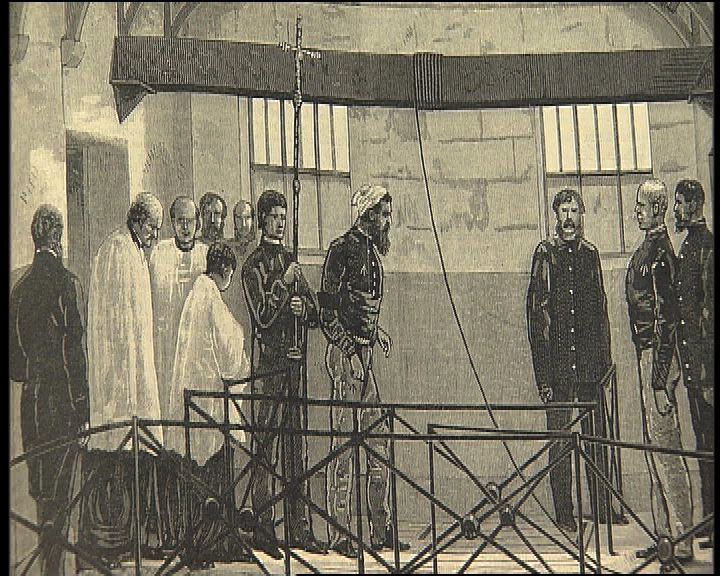 Kelly’s response shows a remarkable openness and an exercised conscience as he reflected on his bushranging exploits. "I have heard all that you said this morning…I believe it all. Although I have been bushranging I have always believed that when I die I have a God to meet…When I was in the bank at Jerilderie, taking the money, the thought came into my mind, if I am shot down this moment how can I meet God?" Coles and Kelly then knelt side by side and prayed together. Upon standing Kelly crossed himself and thanked the preacher for his ministry. This was the last time the two men spoke together. Before long Kelly went to the gallows. Coles did not attend the execution. "I could have done the man no good by doing so,” he reflected, “and was saved the pain seeing a fellow creature ushered into the presence of God.”
This is a touching portrait of a little known instance of pastoral care in a moment of personal crisis. Kelly the penitent Catholic Christian kneels beside Coles the forthright Wesleyan preacher, the two men together calling upon God to grant mercy to a fallen sinner.
If you enjoyed this blog entry you might also enjoy the following: Ned Kelly and the Anglican Bishop; The History Wars; "Wiping Out" the Aborigines and The Proposition
Ned Kelly and the Anglican Bishop
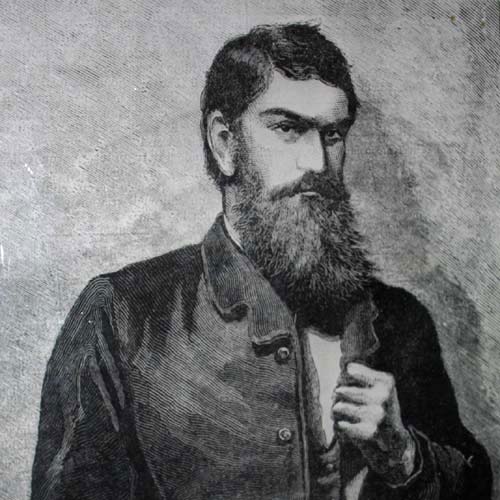 Bushrangers have been seen as heroes and champions of the underdog, who, Robin Hood style, robbed from the rich to give to the poor (or at least to unseat the rich from the arrogance of privilege). On the other hand, they have also been seen as mad dogs, murderers, scoundrels, and rebels, deserving the full weight of civilization’s unbending justice. Australia’s most famous bushranger Ned Kelly (1855-1880) has generated both sets of sympathies.
According to Bill Gammage, “Bushranger is an Australian word. It evokes bushcraft, daring, defiance, and freedom from convention, rather than crime or evil. It touches an Australian nerve [as evidenced by] G. T. Dicks’ 1992 A Bushranger Bibliography [listing] over 1200 books [almost 100 on Ned Kelly]." Sympathy for Kelly is not something read back anachronistically into a distorted past. It began during his lifetime and has continued to the present. I recently came across the following interesting incident in Morna Sturrock’s biography of Bishop James Moorhouse, Bishop of Magnetic Power (2005) while reviewing her book for History Australia, which brings sympathy for Kelly into focus. The second Anglican Bishop of Melbourne, Moorhouse, visited north-west Victoria in October-November 1878. The newspaper headlines spoke of the “Mansfield Outrage,” Sgt. Michael Kennedy having been shot dead by Ned Kelly, alkong with three other cionstables, at Stringybark Creek. His body was brought into Mansfield and Moorehouse was called upon to preach there. Kennedy (and Kelly) were Catholic but Moorehouse visited his grieving widow to console her and also to strongly advise her against viewing “the poor disfigured corpse” of her husband. Half his face had been shot off and a wild animal had chewed off his left ear sometime over the three days his body lay in the bush before it was discovered. "She agreed," wrote Moorhouse, "that I should go and see if the sight were fit for her; and when I told her it would be wicked for her in her state of health to subject herself to such a shock, she went quietly home. I attended the poor Sergeant’s funeral. The Priest asked me to walk with him at the head of the procession."  The funeral service, from St. Francis Xavier’s Catholic Church was quite an ecumenical occasion with Moorehouse leading the procession along with Father Scanlan, Samuel Sandiford, the Anglican rector of Mansfield, and the local Presbyterian minister, the Rev. Reid. In the age of sectarianism this is quite notable. Father Scanlan had ridden by night, “along the wild road from Benalla, with the reins in one hand, and a revolver in the other.” While standing in solidarity with the victims of the crime and insisting that the perpetrators should be tracked down and arrested, at the same time Moorehouse showed remarkable sympathy for the Kelly Gang. "Poor wretches! One cannot help pitying them, crouching among the trees like wild beasts – afraid to sleep, afraid to speak, and only awaiting their execution. But bushranging is so horrible, so ruthless, so utterly abominable a thing, that it must be stamped out at any cost." Two days after the funeral while preaching in the church at Mansfield he repeated these remarks, prayed for the murderers and told the people they should “pity the poor wretches who caused us to mourn over these disasters.”
Not long after the funeral, Moorehouse and his wife stopped at an inn in Benalla for a meal and a change of horses. They were surprised to notice Chief Commissioner Standish, who was overseeing a yearlong search for the Kelly Gang, leave the inn without speaking with them. As the Moorehouses moved on they noticed a mounted policeman up ahead of them and others stationed here and there along their route as if keeping watch over them. Upon returning to Melbourne he was informed that the Kellys were angry at the Bishop’s influencing of public opinion against them and had planned to kidnap him, spirit him away to the mountains and hold him for ransom. While enjoying a smoke in the garden of the inn he had been in range of their rifles. However, some of the Kelly supporters thought such an action would damage their cause and so warned the police; hence the armed escort.
Many alienated small farmers and farm labourers became Kelly “sympathisers.” John McQuilton’s The Kelly Outbreak (1979) describes widespread agricultural ignorance, poverty, and disillusionment in north-east Victoria at this time. Colin Holden’s history of the Diocese of Wangaratta, Church in a Landscape, states that the Kelly Gang enjoyed support in the local community because struggling farm workers saw Kelly’s plight as an exaggerated form of their own situation. Rural newspapers of the day noted that the Kellys also enjoyed support among “the respectable and well-to-do” people, including Anglicans, “who might in other circumstances appear as supporters of law and order.” The Church of England Messenger said that bushrangers could always count on finding “punctual provisions and trusty spies among the settlers in the remote districts.” In discussing the question of whether Kelly should be viewed as a violent psychopathic criminal or a hero of the people, more sinned against than sinner, one of my students asked whether 100 years ago we would be remembering serial killer Ivan Mallatt as favourably as we remember Kelly today. The answer to the question is “no” for many reasons, but one of those reasons is that Kelly was a popular figure in his day. Ivan Mallatt and his kind have no supporters. They are psychopaths who seem to kill for no reason and with no remorse. 38,000 people signed a petition for Kelly’s pardon. No one today advocates for Millatt. Kelly was a violent man enmeshed in the criminal underworld of north-east Victoria in age of widespread police brutality and corruption. Criminals are the results of both nature and nurture; communities produce them as much as women give birth to them. It was “not easy being an Irishman in Queen Victoria’s colony.” People do not commit crimes simply because they are evil and the world is not a place made up of men and women who are either good or evil. We are more complex creatures than that. I think Bishop Moorehouse understood this and so he prayed for the “poor wretches” who made up the Kelly gang and he exhorted his flock to have pity on them. So was Kelly a hero or a criminal? Probably both.
If you enjoyed this blog entry you might also enjoy the following: Ned Kelly and the Wesleyan Preacher; The History Wars; "Wiping Out" the Aborigines and The Proposition
Thursday, October 27, 2005
It's Official!

Last Thursday (20 October) I received a call from my supervisor John Hirst to let me know that my PhD thesis has been approved without the need for any major rewrites or revisions (just a few minor changes). It feels great to have it finished. The following words from Martin Luther (pictured above) should keep me well grounded: "If you feel or imagine that you're right and suppose that your book, teaching or writing is a great achievement...then my dear man, feel your ears. If you are doing so properly, you will find that you have a splendid pair of big, long, shaggy, asses' ears."
Friday, October 07, 2005
Where's my PhD?

I'm feeling a little melancholy today as La Trobe University's graduation ceremony went ahead without me! I submitted my PhD thesis in April and here it is six months later and I'm still waiting to hear from my examiners! This is not at all as I imagined it would be. John Capper reminded me today that Karl Barth (pictured here hobnobbing with Catholic theologian Hans Kung in 1966) never even HAD a doctorate. He never had a blog either.