Showing posts with label Worship. Show all posts

Monday, November 30, 2009

Review of Robert Gribben's "Uniting in Thanksgiving"
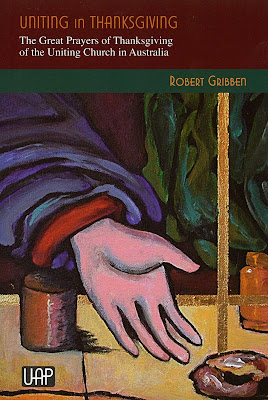
Robert Gribben, Uniting in Thanksgiving: The Great Prayers of Thanksgiving of the Uniting Church in Australia. Melbourne: Uniting Academic Press, 2008.

This book is an extended commentary on the Eucharistic Prayers in use in the Uniting Church. Professor Gribben is admirably equipped for this task having been closely involved in the authorship of the prayers themselves as a member of the team that produced Uniting in Worship. I am a great admirer of the Uniting Church's liturgy and would that my own church would take as much care over its worship, or at least make some services available for those of us who want to do more than mimic Hillsong, recreate a camp meeting atmosphere, or make it up as we go along.

The Uniting Church has Prof. Gribben to thank for such admirable phrases in the Thanksgiving for Creation as, "In time beyond our dreaming you brought forth light out of darkness" and "We bless you for this wide, red land, for its rugged beauty, its changing seasons," words which evoke the Uniting Church's commitment to be an authentically Australian church. The expression in the Narrative of Institution, "Do this for the remembrance of me" rather than the expected "in remembrance of me" is something quite unique. It is a noble attempt to capture the meaning of anamnesis, which is so much more than just a reflection on a past event, but more a lived experience of participation. If the wording is at first a little disarming, this may lead to deeper reflection on their meaning which can only be a good thing.

The book is divided into three sections. First the "Genealogy" of the Great Prayer of Thanksgiving is given, tracing its historic precedents and giving an idea of its general structure and "theo-logic." Part Two, the lengthiest section of the book, is an extended commentary on each section of the Prayer, and a final third part is a practical commentary on its use. So the reader moves neatly from provenance, to meaning, to rubrics.

The book is a delight to read. Prof. Gribben writes in fine, engaging style. He is an internationally known liturgist and ecumenist who knows his material well. In addition to a deep familiarity with the Christian Church's wider liturgical and sacramental theology, being nurtured in the Wesleyan tradition, his appreciation for and knowledge of Methodism is clear throughout. The commentary is sprinkled with judicious anecdotes that keep the reader engaged and often shine a light on the theological meaning being considered.

This book certainly deserves to be read by members of the Uniting Church but anyone with an interest in Christian worship will benefit from it. One would hope that it would be used as a text in the training of Ministers of the Word and others responsible for leading worship in the Uniting Church. The provision of such a theologically well grounded liturgy needs to be accompanied by careful instruction regarding its use and this book meets that need admirably. It would be a pity if it were not widely read and used.

A word must also be said for the editors of Uniting Academic Press for the attractive design of the book, the first release from this new publisher. The glossy card insert which reproduces the Prayer itself is a useful tool for use in worship and makes a helpful bookmark, though sadly it has some typographical errors.

You can order the book from Mosaic Resources.

Thursday, August 30, 2007

Loose Lips Sink Ships

There is a lot of loose speaking in our worship that doesn't help maintain a proper Trintarian emphasis. For example, there is a lot of what the old theologians used to call "confounding of the Persons." "Dear Father, we thank you Lord, that you died on the cross for us..." Now, of course, the Father did not die on the cross, but the Son. Sometimes you will hear a prayer like the following: "We thank you Father Lord that Lord Jesus you came Father God and helped us Lord to see, Jesus, that we are never alone Father..." and so on. As well as confounding the persons, this prayer borders on blasphemy because in using words like "Father" and "Lord" as a substitute for "um or "ah," as the person collects his or her thoughts, the speaker uses the Lord's name "in vain" (i.e. in an "empty" or mindless way). My advice here would be to slow down, speak more slowly, engage one's brain before one's mouth, and think about what is being said instead of prattling on a like a nervous nanny.

With only two exceptions, prayer in the New Testament is always offered TO the Father, IN THE NAME of Jesus, and THROUGH the Holy Spirit. (The exceptions are when Stephen is being stoned to death and he looks up to heaven, sees Jesus and prays, "Lord Jesus receive my spirit" and the prayer at the end of Revelation, "Even so, come Lord Jesus.") I am not aware of any prayer in the New Testament made directly to the Holy Spirit. This does NOT mean that prayer directly to Jesus or the Spirit is wrong, but that the general biblical pattern seems to be a Trinitarian one in which the Father is addressed on the basis of what Christ has done and with the
authority that lies behind his name, and (since we don't know how to pray as we ought) the Spirit helps us in our weakness by interceding within us, empowering and enabling our speech.

Of course God looks at the heart and I don't mean to say here that when Christians pray in a theologically loose way or in a way not quite "proper" or not fully Trinitarian that those prayers go unheeded or that God says, "Go directly to hell; do not pass Go; do not collect $200." (Monopoly players know what I'm talking about.) God is patient with us, of course, but congregational leaders have the responsibility of modelling best practice.

Sadly, many Christians are functional unitarians (there is one God and his name is "Jesus") or "binitarians" ("God and Jesus" with no Holy Spirit to be seen). Some people say Pentecostals focus too much on the Spirit in their worship but the way I see it the tendency among both Pentecostals and Evangelicals is the same, and that is, to be one of the two options I've just given.

The Gloria Patri doesn't get used among us much anymore and in a way that's a pity because it enshrined a Trinitarian doxology in every service. "Glory be to the Father, and to the Son, and to the Holy Spirit; as it was in the beginning, is now and shall be forever. Amen." Even without the use of the Gloria Patri we can still ensure a Trinitarian shape to our prayers - don't confound the Persons, never use "Father," "Jesus" or any other of God's names as a "filler," and frequently close with "in the name of the Father, and of the Son, and of the Holy Spirit."

Trinitarian blessings (benedictions) also help as do Trintarian hymns and songs. However, Reginald Heber's "Holy,Holy, Holy" (as great as it is) is not the only Trinitarian hymn out there! I love the final verse of "Now thank We All Our God" - "All praise and thanks to God the Father now be given; The Son and Holy Ghost, supreme in highest Heaven; The one eternal God,whom earth and Heaven adore; For thus it was, is now, and shall be evermore." This can be separated from the rest of the hymn as a stand alone Trinitarian doxology that could be sung, for example, as a response to the Psalm or other Bible reading. Don't be fooled into thinking that just because a song has "Father, Son, and Holy Spirit" in the lyrics that it is Trinitarian because it ain't necessarily so. Some songs are quite theologically incoherent (that is, they don't "co-here"). For example, consider the chorus "How Great is Our God" which says "Father, Spirit, Son / the Godhead Three in One / the Lion and the Lamb." This seems all wrong to me. Firstly, the only reason to change the order of "Father, Son, and Spirit" is to make the rhyme work - "Son" has to rhyme with "One." The placement of these words is not just traditional but deeply theological in its ordering. The Father begets the Son, the Spirit proceeds from the Father (or from the Father and the Son if you accept the Nicene formula). Also the address to the Triune God (Father, Spirit, Son / the Godhead Three in One) suddenly shifts without warning and without reason to an address to the Son (the Lion and the Lamb) as if the same persons were still being addressed, which they are not because only the Son is "the Lion and the Lamb." Call me a liturgial fundamentalist if you like but I think the way we address God in worship is an important matter that deserves serious reflection.

By the way, you may wonder why I have chosen the images I have used here. I believe they reflect one of the most disturbing things about contemporary worship trends. Though two of the images here show very large groups of worshippers, each person seems wrapped in his or her own personal bubble of worship intimacy. The three young women in the third photo each have their eyes closed, communing with Jesus, their "personal" Saviour, each with her own microphone. In none of these photos is any one person present to any other person. They do not face each other, they do not engage. They are transcended beyond others to a private space shared only between God and themselves. If God is a Being whose very existence is a reciprocal, relational one, you would think our worship would reflect that reciprocity by being more communal than personal and ecstatic. You would think.

AddThis

Share |